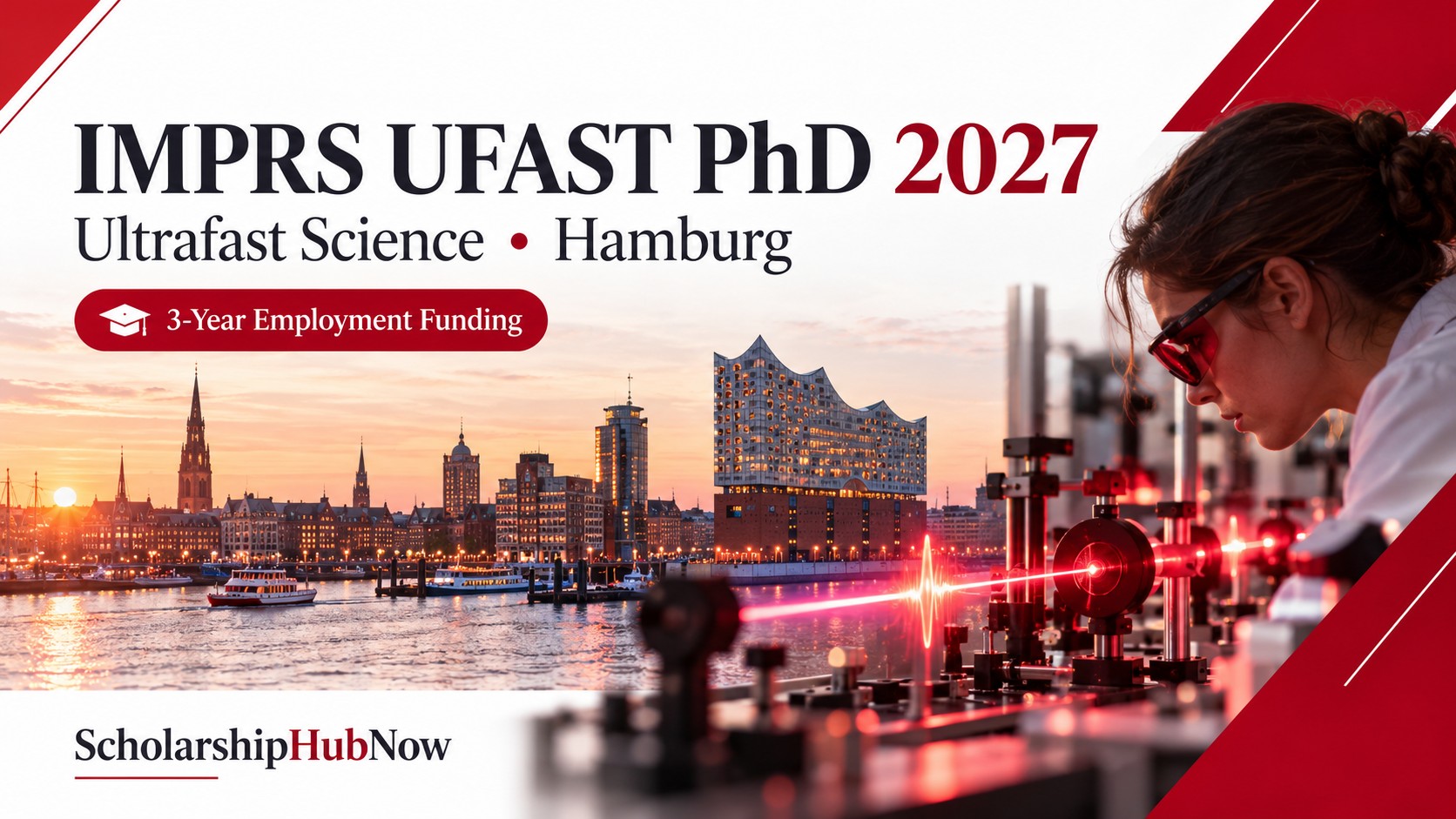
IMPRS UFAST is accepting applications for 23 interdisciplinary doctoral projects in Hamburg, with three-year employment contracts. Apply by 6 November 2026; recommendation letters are due 12 November 2026. The entry-2027 guide identifies late summer/early autumn 2027 as the preferred start.
Official sources checked 19 October 2026. No cutoff hour or time zone is stated in the checked application page or guide.
Funding: employment, not a quoted universal stipend
The Max Planck job announcement offers a three-year contract under the German federal pay agreement. It does not specify a universal monthly amount. Request the applicable pay group, percentage, deductions and extension conditions from the employer.
The programme FAQ says positions are funded through work contracts and there are no doctoral tuition fees. Universität Hamburg registration carries a semester fee; the FAQ’s approximate €310 figure should be checked against the current university rate before budgeting.
Budgeting guidance: Separate gross salary from money available after deductions. Include deposits and relocation costs in an arrival budget, not only a monthly spreadsheet. A funded contract is valuable, but the exact offer—not another institute’s pay example—should determine your financial plan.
Who should apply?
The programme welcomes international candidates with an MSc completed or nearing completion in physics, chemistry, biochemistry or a suitable related field. The degree must be completed before doctoral study begins. Research and instruction are in English.
Ultrafast imaging and structural dynamics connect physical methods with questions in materials, chemistry and biology. Our interpretation: Applicants should demonstrate why resolving processes in time or structure is necessary for their scientific question. Interest in a famous facility alone is not evidence of project fit.
Choose projects with a clear rationale
The current call lets applicants choose up to two advertised projects. It lists a CV, motivation/research-interest letter, English master’s-thesis abstract, bachelor/master certificates and transcripts, plus English evidence where applicable.
Applicant-fit exercise: For each proposed choice, write three private notes: the question being studied, the technique or theory required, and the strongest evidence that you could begin learning or contributing. If you cannot explain the difference between your two choices, read further before selecting them.
For imaging work, distinguish an attractive image from a measurement that tests a claim. For theory, identify which approximation makes the problem tractable and where it could fail. You need not know every answer, but your application should reveal how you reason about uncertainty.
Submission: prepare the complete file first
The entry-2027 guide warns that the online application must be completed in one step and cannot be revisited to amend it. Documents must be in English; one merged PDF is recommended. Motivation and thesis abstract are each limited to one A4 page.
- Read the project descriptions and application guide.
- Check degree and language eligibility against your proposed start.
- Prepare the complete documents and obtain referee agreement.
- Inspect the merged PDF for missing pages and unreadable scans.
- Submit once and follow the final-screen referee instructions.
The guide requires two referees and makes applicants responsible for requesting letters. Keep your applicant number and monitor messages, including spam.
Practical safeguard: Reopen the final PDF on a second screen or device. Check names, dates, page order and legibility at normal zoom. Keep a record of submission and reference completion. An email asking for a letter is not evidence that the letter arrived.
Official-source caveats to resolve
The job advert contains a 2026 start-year statement, but the linked guide is explicitly for entry 2027. Follow the guide and confirm the agreed start with the coordinator.
English-test timing also differs: the FAQ permits application with a scheduled test after the deadline, while the 2027 guide says results must be available by 6 November for further consideration. Obtain written clarification before relying on a pending result or waiver.
Selection and interview preparation
The selection page describes committee shortlisting, a Hamburg workshop with a research talk and supervisor interviews, then programme acceptance for candidates offered supervision. Workshop travel and accommodation are covered. The current call schedules it for 8–10 February 2027.
Preparation advice: Build a short talk around one question you investigated, rather than a catalogue of methods. Explain your own contribution, a decision that changed the work and one limitation. Practise describing what your evidence does not establish. This supports a scientific conversation more effectively than rehearsing impressive terminology.
Frequently asked questions
Are all 23 projects guaranteed to recruit?
Do not assume the number of advertised projects equals the final cohort. Selection and supervision offers determine admission.
Can I apply by email?
No. Use the official online form.
Is a fixed monthly salary published?
No universal amount appears in the checked call. Confirm your offer’s terms.
Can I edit the file after submission?
The guide says no. Contact the office for advice if you submitted an incomplete application.
Apply Now — Official IMPRS UFAST Application
Compare related doctoral routes
- Munich Quantum Valley fellowships
- IMPRS-STNS nano-systems research
- Max Planck Schools graduate routes
Compare project fit, entry requirements and confirmed contract terms, not only the funder’s name.
Official sources
- Current application call
- 2027 application guide
- Eligibility and funding FAQ
- Employment announcement
- Selection process
ScholarshipHubNow is independent of the programme. The provider decides eligibility and selection.