Leipzig School of Human Origins PhD 2027: Funded Positions
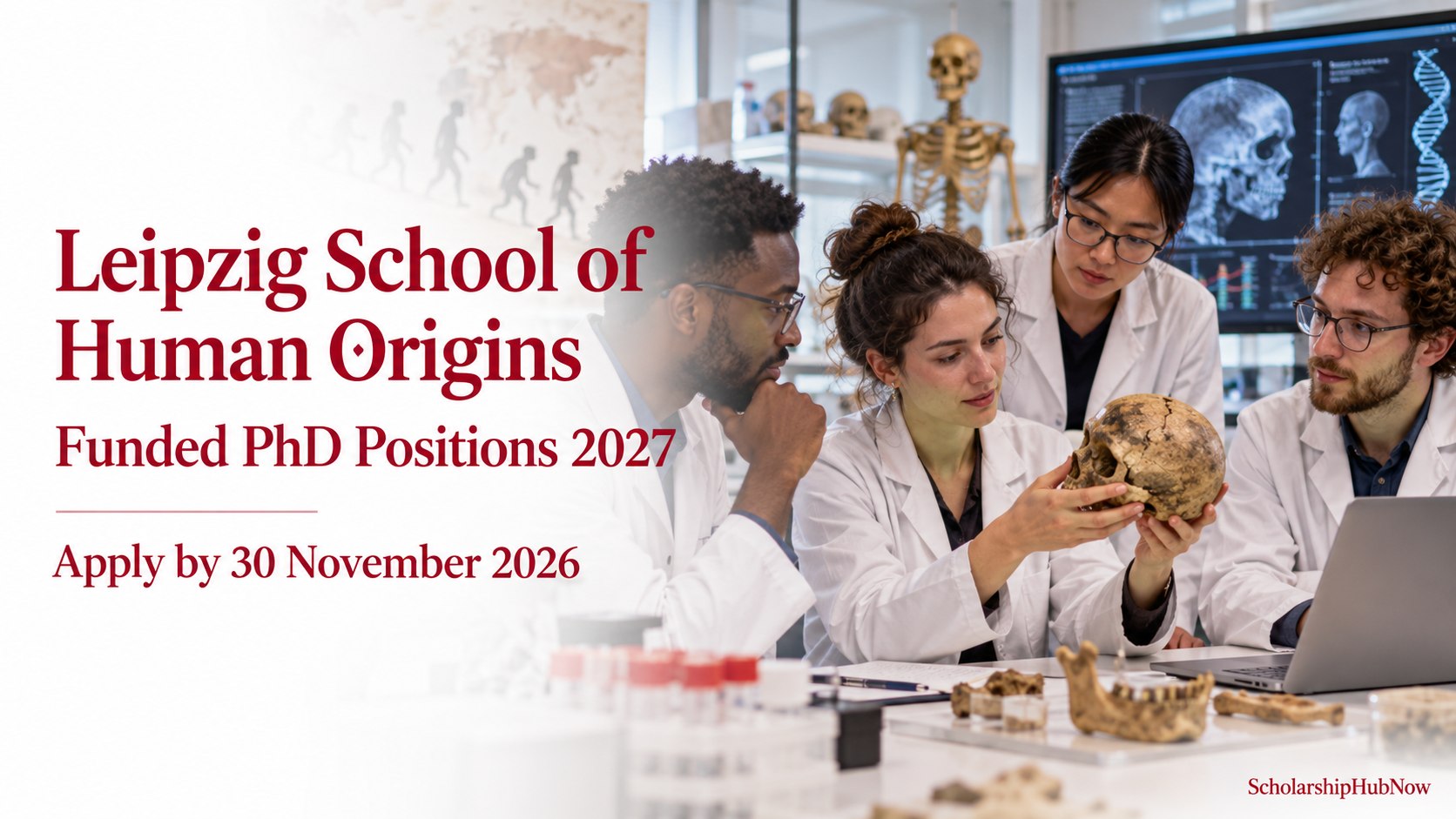
Leipzig School of Human Origins is recruiting funded PhD researchers for September 2027. Applications close on 30 November 2026. The school connects the Max Planck Institute for Evolutionary Anthropology with Leipzig University. International applicants with a relevant master’s degree can apply; students finishing that degree must receive it before joining.
Official information checked: 24 October 2026. No exact deadline cutoff time or time zone is published.
Leipzig Human Origins PhD 2027: quick details
| Country | Germany, based in Leipzig |
|---|---|
| Institutions | Max Planck Institute for Evolutionary Anthropology and Leipzig University |
| Level | PhD |
| Start | September 2027 |
| Deadline | 30 November 2026; cutoff time not stated |
| Applicants | All countries, subject to academic requirements |
| Language | English; German not required |
| Application | Online portal linked from the current call |
Research areas and applicant fit
The programme focuses on human and primate evolution. Its three broad areas are Molecular Anthropology; Human History, Evolution and Ecology; and Language, Culture and Cognition. Applicants may select up to three departments or research groups, but successful candidates join one area.
The programme overview describes a typical thesis duration of three to four years and interdisciplinary training alongside research. Choose a group by its current questions and methods. A relevant degree is a starting point; a strong application explains how previous work prepares you for that particular group’s research.
Funding and costs
The current call lists Max Planck support contracts at 65% of TVöD E13, Leipzig University contracts, or third-party funding. These are different funding routes. The percentage describes a contractual salary basis, not a fixed take-home stipend. Ask for the precise pay, duration and conditions of your own offer.
The school’s financial-support page confirms that participation in this doctoral programme has no tuition fee. Budget for personal living and relocation costs rather than assuming each expense is separately reimbursed. Optional university registration can carry semester charges; check current enrolment guidance before making a 2027 budget.
Eligibility
The academic requirements welcome applications worldwide with a relevant master’s or equivalent qualification involving substantial original research. Backgrounds include anthropology, biology, biochemistry, computational biology, bioinformatics, evolutionary genetics, linguistics, psychology, statistics and related subjects. A bachelor’s degree alone is insufficient, even if it lasted four years and included a thesis.
You can apply while completing your master’s, provided it is awarded before the start. Applicants need fluent written and spoken English. German is not required. The official FAQ says TOEFL is not an absolute requirement for a complete application; applicants must still demonstrate English proficiency.
Documents checklist
- Motivation letter, limited to one page, covering research experience and interest in the selected group.
- CV, with publications where applicable.
- Undergraduate transcript and proof of the most recent degree, plus academic records requested in the portal.
- Names and contact details of two referees, with their prior agreement to be contacted.
The live application form includes fields for English evidence and optional achievements. Check the actual upload instructions before preparing files. An incomplete application is not processed.
How to apply
- Read the current call and confirm the available research-group choices.
- Rank up to three suitable groups. Read their recent work and identify a credible match.
- Prepare your documents. Keep the motivation letter within one page and explain your own role in previous research.
- Register through the official application portal. Use the link on the open-positions page. The process allows progress to be saved.
- Submit and check the confirmation. The application guidance says confirmation may take up to 30 minutes.
- Follow up with referees. The school invites referees after an initial formal check. Its guidance asks applicants to ensure both letters arrive before the deadline, so submit well in advance.
See the official application procedure for the recommendation-letter workflow.
Apply now — official call and portal
Deadline and selection
The deadline is 30 November 2026. The call gives no cutoff time or time zone. Do not rely on an assumed midnight deadline, particularly because references require additional processing.
The published selection procedure describes review from January to March/April, followed by an April/May recruitment event and possible further interviews. These are general procedural windows rather than confirmed individual appointment dates. Selection considers academic performance, research experience, motivation and references. Invited applicants discuss earlier work and group fit. Travel and accommodation are typically covered, subject to invitation terms.
Practical tips from ScholarshipHubNow
Use the short letter strategically. Describe a research question you worked on, methods you used, a concrete contribution and why the selected group is a suitable next step. Avoid spending most of the page repeating the institution’s reputation.
Choose evidence relevant to the group. Computational applicants can highlight reproducible analysis; field researchers can demonstrate study design and data collection. These are editorial suggestions, not additional formal requirements. A few well-explained examples are more useful than a long list of unrelated certificates.
Plan the referee timeline first. Ask suitable researchers whether they can provide a detailed assessment, and share your CV and intended group choices early. Keep copies of submission confirmations.
Frequently asked questions
Can international applicants apply?
Yes. Applications are welcomed from all countries, subject to academic eligibility and research fit.
Can I apply before my master’s finishes?
Yes, but you must receive the degree before starting in September 2027.
Is the doctorate remote?
No. The FAQ says accepted researchers work in Leipzig.
Is every position funded identically?
No. Max Planck contracts, university contracts and third-party funding can have different terms. Confirm your individual offer.
Related doctoral opportunities
Compare research fit and funding terms with Max Planck Chemical Ecology PhD positions, Oxford Generative Biology and Oxford Intelligent Earth. Browse Germany Scholarships and PhD Scholarships for other subjects.
Official sources
Check the recruitment call, requirements, application instructions, selection procedure and funding guidance. Provider instructions and the individual offer take precedence if details change.