Oxford IMAT PhD 2027: Funded Materials Studentships
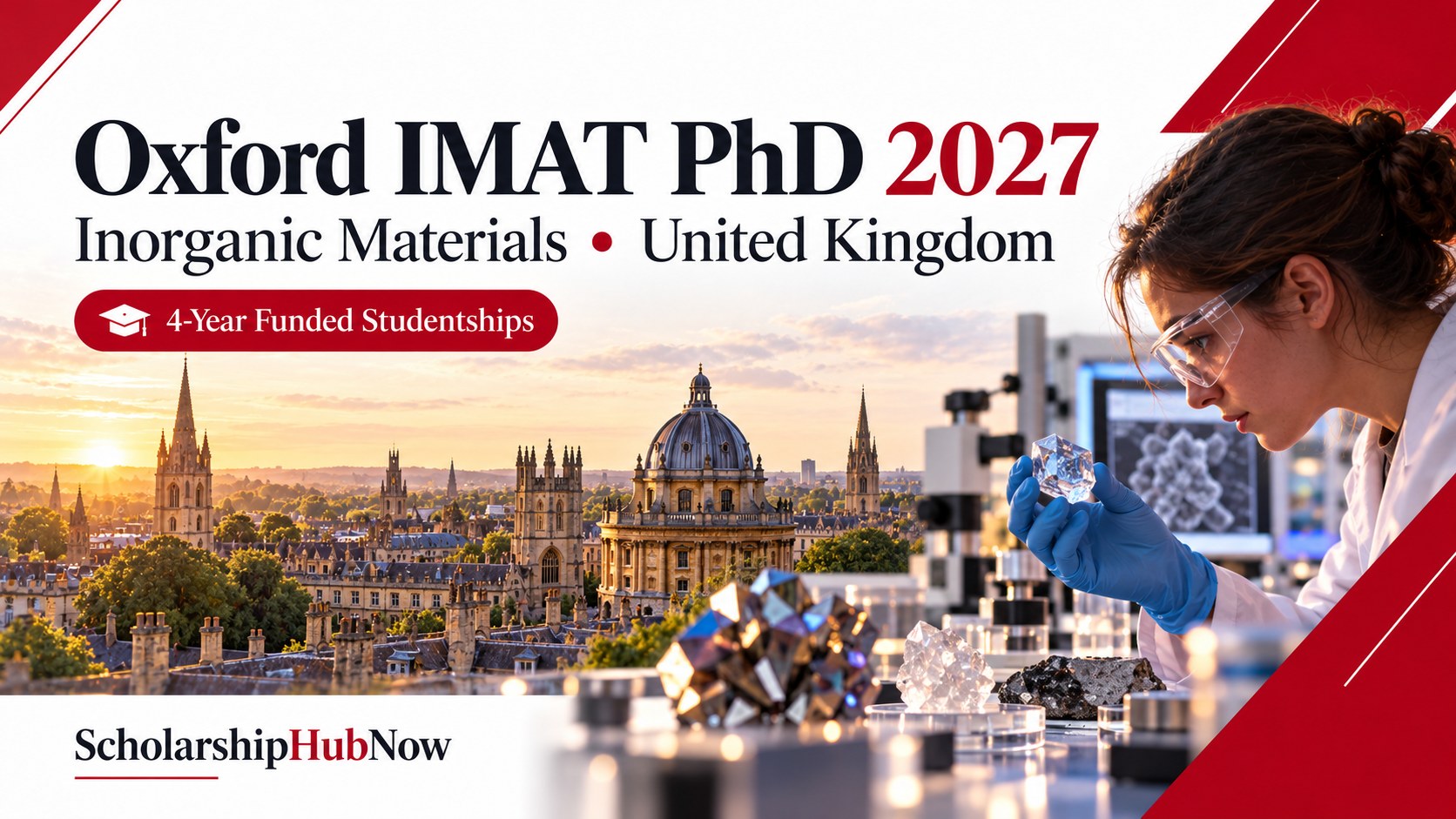
Oxford IMAT PhD 2027 applications are open for four-year funded studentships in inorganic materials and advanced manufacturing. The next deadline is 13 November 2026 at 12:00 midday UK time. International applicants can compete for full funding, within the programme’s overseas allocation limit. Funding and admission remain competitive.
Official sources checked: 21 October 2026.
Oxford IMAT PhD 2027: key facts
| Host | University of Oxford, United Kingdom |
|---|---|
| Programme | Inorganic Materials for Advanced Manufacturing, EPSRC CDT |
| Duration | Four years |
| Awards advertised | 13 fully funded studentships annually |
| Next deadline | 13 November 2026, 12:00 UK time (GMT) |
| Later funding deadline | 6 January 2027, 12:00 UK time |
Funding: what international applicants should know
The CDT confirms full funding is available to overseas students within UKRI’s limit of up to 30% of funded places. Full studentships cover course fees and a living stipend. The FAQ still quotes £20,780 annually as its current stipend; do not treat that figure as a confirmed 2027/28 award rate. Ask the team for the applicable rate and award conditions before accepting. An admission offer alone should not be treated as a funding guarantee.
Applicant guidance: request written confirmation of the stipend, fee coverage and any costs you must meet yourself. Build a separate budget for relocation and immigration rather than assuming every expense is reimbursed.
Eligibility and applicant fit
Oxford normally requires a first-class or strong upper-second-class degree in a relevant subject, including chemistry, materials science, physics, biochemistry or chemical engineering. A master’s is preferred rather than compulsory. English must meet Oxford’s higher level. Check the current official testing policy before booking an exam.
Our assessment: this is a particularly useful route if you can explain how your scientific skills connect to a materials problem. A strong degree title is only the starting point. Your statement should connect a technique you have used, a research question you want to investigate and the advertised project’s scientific direction.
Choose projects before writing your statement
The official 2027 project list includes sustainable fluorination, solar-cell materials, diagnostic MOF films and machine learning for grain boundaries in ceramics. Choose three projects in order of preference.
Practical approach: make a shortlist with columns for scientific question, methods, prior experience and skills to learn. For a computational project, explain your modelling experience and how you validate results. For a synthesis project, discuss experimental decisions and characterisation. Avoid sending the same generic motivation paragraph for three scientifically different projects.
Documents and application steps
- Review the official project list and supervisors’ research.
- Prepare transcripts and a 1,000-word personal statement; identify your three preferred projects.
- Register three academic or professional referees and arrange timely submission.
- Apply through Oxford’s graduate system to Inorganic Materials for Advanced Manufacturing (EPSRC CDT), course code R34_1. The CDT advises leaving college choice open.
- Check the current course requirements and submit before the relevant deadline.
Use the CDT application checklist alongside Oxford’s current admissions page. They should be read together rather than treating this guide as the application form.
Selection and interview preparation
The FAQ weights academic achievement, references, and motivation/programme fit equally. Shortlisted candidates face a technical panel and meetings with potential supervisors.
Preparation advice: practise explaining why a method was appropriate, what its limitations were and what experiment or calculation you would run next. Read the assigned paper critically: distinguish the authors’ evidence from their interpretation. Prepare questions about project supervision, facilities and the skills needed in the first year.
FAQs
Can international students receive full funding?
Yes, within the overseas allocation limit. Selection is competitive; obtain the award terms in writing.
Is the 2027 stipend amount confirmed?
The sources checked do not establish a distinct 2027/28 stipend rate. The older figure on the FAQ should be clarified with the CDT.
Which start date should I use?
The central course page gives 20 September 2027; the CDT application page describes October 2027 entry. Confirm the reporting date with the programme.
Should I wait for the later deadline?
Our advice is to prepare for the November round if your application is ready, while checking that your references and preferred projects are available.
Apply now and compare alternatives
Apply Now: Oxford IMAT official admissions and application link
Compare funding routes through our guides to Cambridge NanoDTC, Imperial President’s PhD Scholarships and Oxford Clarendon. Each has its own eligibility and selection rules.
Official sources
- Oxford course: deadlines, entry requirements and funding
- IMAT application instructions
- IMAT FAQs: funding eligibility and selection
- 2027 research projects