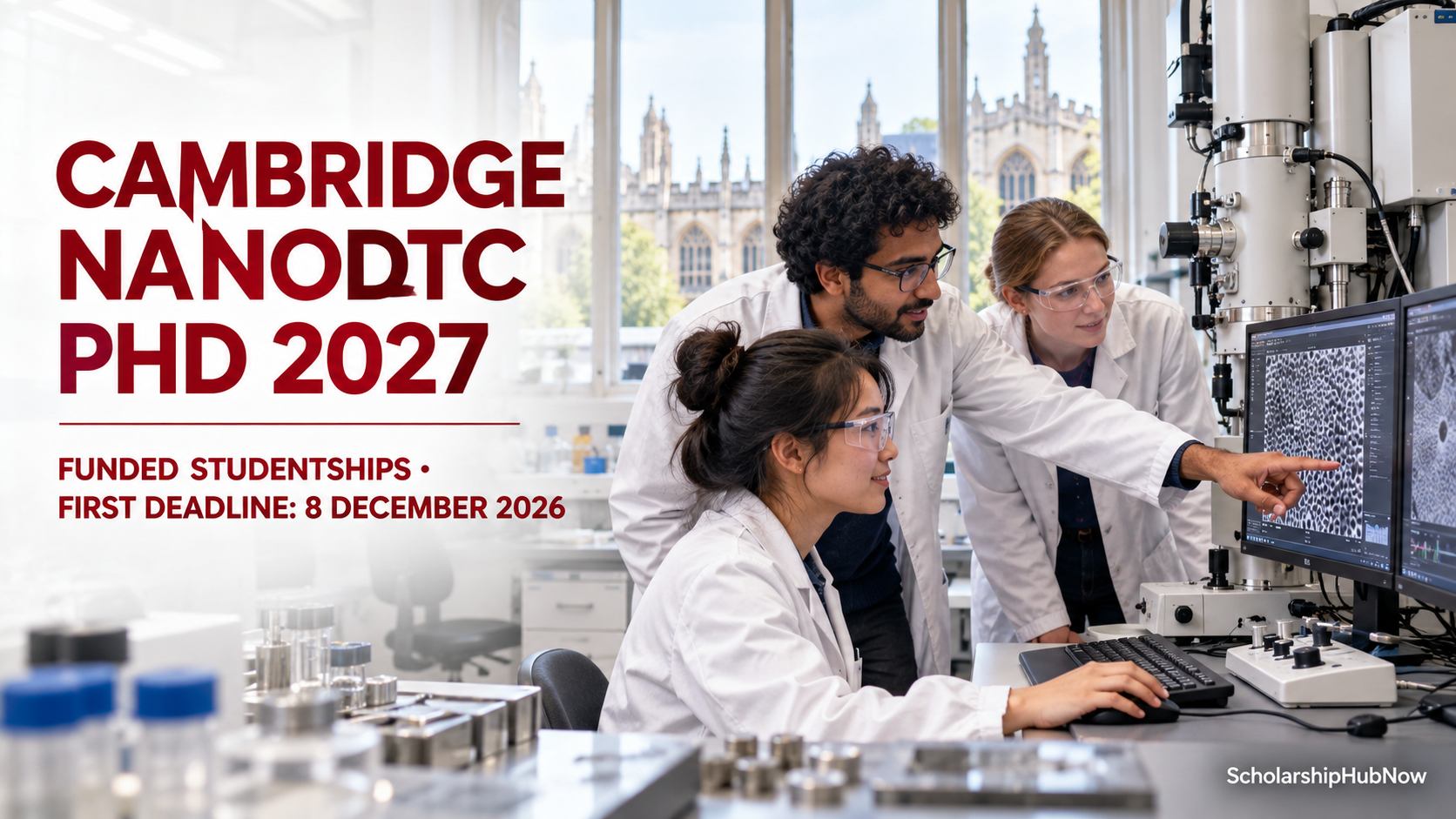
Cambridge NanoDTC is accepting applications for its 3.5-year PhD programme for October 2027 entry. The first review deadline is 8 December 2026 and the second is 2 January 2027. Fully funded studentships covering University fees and a maintenance stipend are available competitively to Home-fee applicants; overseas applicants may receive Home-level fees and maintenance plus a competitive top-up, so full overseas funding is not guaranteed.
United Kingdom
PhD
8 December 2026
2 January 2027
Funding and benefits
- Home-fee applicants compete for studentships covering University fees and a maintenance stipend.
- Overseas applicants may be considered for Home-level fees and maintenance plus top-up scholarships for the overseas fee difference.
- Additional competitive routes include Gates Cambridge, Harding and Cambridge Trust funding.
- The cohort receives interdisciplinary nanoscience training before beginning the main PhD project.
Eligibility
- A relevant background in physics, chemistry, materials science or engineering.
- Normally a First Class degree or equivalent.
- Four years of relevant training, such as an integrated master’s or three years plus relevant experience.
- Research experience is essential.
Required documents
- Two academic references.
- University transcript.
- CV.
- Completed Cambridge postgraduate application and statement of interest.
A research proposal is not required. International applicants should verify degree equivalency and Cambridge’s English-language requirements for their country and course; the NanoDTC page does not state a separate universal test score.
How to apply
- Open the official Cambridge course application.
- Complete the postgraduate form and NanoDTC statement of interest.
- Upload the transcript and CV.
- Invite two suitable academic referees and ensure references arrive by the applicable funding deadline.
- Select the relevant funding boxes for Cambridge-wide funding consideration.
- Submit by 8 December 2026 for the first review, or no later than 2 January 2027 for the second review.
Deadline
The programme lists 8 December 2026 and 2 January 2027 as internal review deadlines. No exact closing time or time zone is stated on the NanoDTC page. Overseas candidates seeking full University-based funding should follow the page’s 2 January 2027 funding instruction.
Selection process
Selection has two stages. Shortlisted applicants complete an individual written task and virtual group discussion. Successful candidates then attend a remote two-day event with technical interviews, meetings with current students and introductions to the participating departments. Qualifications, abilities, aspirations and experience are considered.
Practical tips
- Apply by the first deadline where possible.
- Explain specific nanoscience interests without pretending to have fixed a final project.
- Use referees who can assess technical and research ability.
- Overseas applicants should plan for the possibility of a fee gap unless a top-up or external scholarship is confirmed.
FAQs
Is NanoDTC fully funded for every applicant?
No. Full studentships are competitive for Home-fee applicants. Overseas candidates may need a top-up for the international fee difference.
Is a research proposal required?
No. Applicants submit a statement of interest instead.
How long is the PhD?
The current programme is 3.5 years, beginning with a six-month training curriculum.
Can international students apply?
Yes, but they should check degree equivalency, English requirements and the overseas funding caveat.
Related opportunities
- Kanders Churchill Scholarship
- Cambridge International Scholarship
- Cambridge BioSCaPe PhD
- Cambridge Harding Scholarship