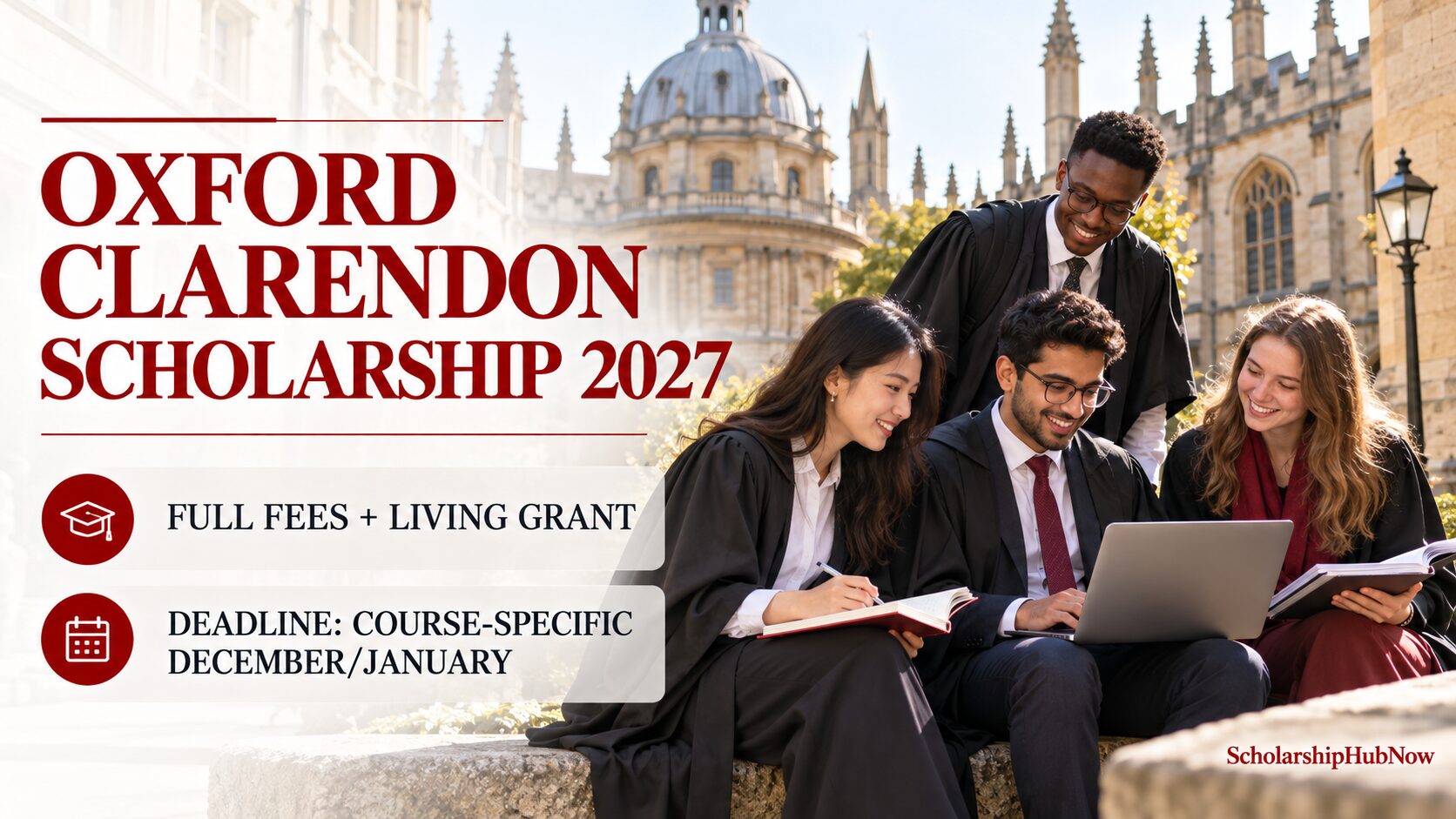
The Oxford Clarendon Scholarship 2027 provides full course-fee coverage and a living-cost grant for outstanding new Master’s and DPhil applicants. Candidates of every nationality and fee status are eligible across all subject areas. There is no separate Clarendon form: applicants are considered automatically when they submit a complete Oxford graduate application by the funding deadline shown for their chosen course.
United Kingdom
Master’s and DPhil
Full fees + living grant
Course-specific December/January
Funding and benefits
- Full Oxford course fees for Home and Overseas fee-status students.
- For full-time scholars, an annual living-cost grant of at least the UKRI minimum doctoral stipend rate.
- Oxford lists at least £20,780 for 2025–26; the 2027 amount has not yet been stated on the Clarendon applicant page.
- Part-time scholars receive a study-support grant whose value depends on the course structure and duration.
- Funding normally lasts for the course’s period of fee liability; continuation charges are not normally covered.
Eligibility
- Apply for a new full-time or part-time Oxford Master’s or DPhil course.
- Any nationality, country of residence, subject area and fee status may be considered.
- Submit the graduate application by the relevant December or January funding deadline for the chosen course.
- Deferred offer-holders and students continuing the same Oxford degree are not eligible.
- Selection is highly competitive and based chiefly on academic excellence and future potential.
Required documents
Clarendon requires no separate scholarship form or additional scholarship documents. Applicants submit the documents required for their chosen Oxford graduate course, which commonly include:
- academic transcripts;
- references;
- a statement of purpose or personal statement;
- a research proposal or written work when the course page requires it;
- evidence of English-language proficiency when applicable.
Requirements differ by course. Applicants must use the individual Oxford course page as the authoritative checklist; Clarendon does not publish one universal document list or English-test threshold.
How to apply
- Choose an eligible Oxford Master’s or DPhil course.
- Open that course’s official page and record its funding deadline and document requirements.
- Prepare the graduate application, references and all course-specific supporting documents.
- Meet the course’s English-language condition if one applies to you.
- Submit the complete Oxford graduate application by the relevant December or January funding deadline.
- Do not file a separate Clarendon application; eligible on-time applicants are considered automatically.
Deadline
Clarendon has no single universal scholarship deadline. The applicable deadline is the December or January funding deadline stated on the page for your chosen graduate course. Oxford does not state a universal Clarendon closing time or time zone on the fund’s applicant page. Treat the exact course-page deadline as controlling and submit early enough for references and uploads to be complete.
Selection criteria and process
Oxford assesses an outstanding academic record, future potential and aptitude, and motivation for the proposed course. Successful scholars commonly hold a first-class degree or equivalent; Oxford gives a GPA of at least 3.7/4.0 as an example, while noting that many awardees score higher and standards vary by discipline.
Departments first assess admission applications and nominate leading candidates. Academic divisions review nominations in February or March, rank candidates on merit and future potential, and forward the shortlist. Most initial Clarendon offers are sent by the end of April. Unsuccessful applicants are not individually contacted; applicants who have heard nothing by mid-June should assume they were not selected.
Practical applicant tips
- Check the funding deadline rather than the later final admissions deadline.
- Use transcripts, prizes, publications and ranking evidence to demonstrate sustained academic strength.
- Choose referees who can assess research aptitude and readiness for advanced study.
- Align the statement and, where required, research proposal with the course’s academic priorities.
- Do not quote the 2025–26 living grant as the guaranteed 2027 figure.
FAQs
Is Clarendon fully funded?
Yes. Oxford describes it as fully funded because it covers course fees and provides a grant for living expenses, subject to the award’s stated duration.
Do international applicants qualify?
Yes. There are no nationality, ordinary-residence or fee-status restrictions.
Is there a separate scholarship form?
No. Eligible applicants are considered automatically through their on-time Oxford graduate application.
What is the exact deadline?
It is the December or January funding deadline on the chosen course page. Clarendon does not publish one date for every course.
Does Clarendon set one English score?
No. English-language requirements are course-specific and must be checked on the relevant Oxford course page.
Related opportunities
- Oxford Ertegun Scholarship 2027–28
- Imperial President’s PhD Scholarships 2027–28
- Warwick PGR Scholarships 2027
- Cambridge NanoDTC PhD 2027