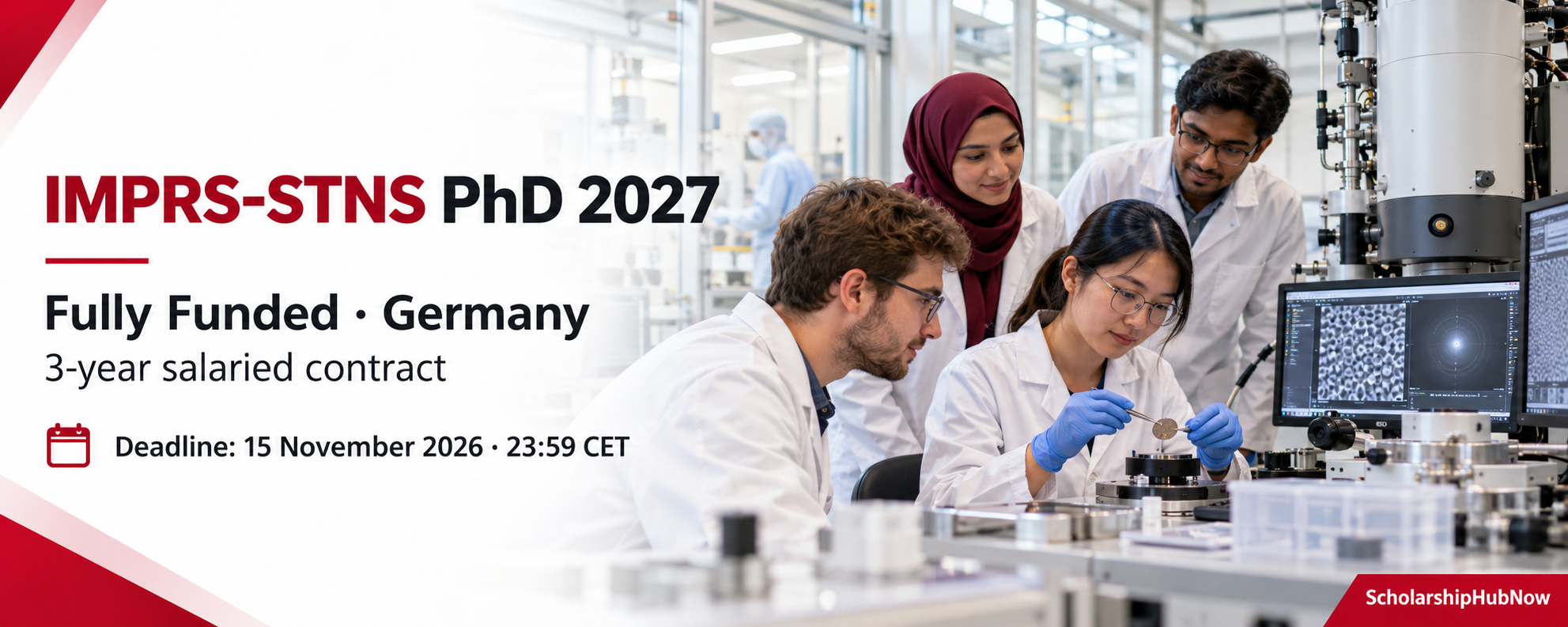
Applications are open for the fully funded IMPRS-STNS PhD positions starting in 2027 in Halle (Saale), Germany. Successful candidates receive a salaried employment contract for three years, statutory social benefits, 30 days of annual leave and no tuition fees. Applications close on 15 November 2026 at 23:59 CET.
The International Max Planck Research School for Science and Technology of Nano-Systems connects the Max Planck Institute of Microstructure Physics and Martin Luther University Halle-Wittenberg. Applicants choose a specific advertised research project rather than proposing an unrelated topic.
Halle (Saale), Germany · PhD
Three-year salaried employment contract
15 November 2026 · 23:59 CET
Funding and benefits
These are employment-funded doctoral positions, not stipends. Depending on the host group, remuneration is based on 65% TVöD E13 at the Max Planck Institute or 50% or 75% TV-L E13 at Martin Luther University. The programme does not publish one universal euro amount because placement and pay scale differ by project.
- Initial three-year employment contract.
- Statutory health insurance, pension and social-security contributions.
- Thirty days of annual leave plus German public holidays.
- No doctoral tuition fees; optional university enrolment may require a semester contribution.
- English-language research environment and language courses.
- Training, mentoring, annual retreat, childcare and family support.
Eligibility
Applicants of any nationality may apply. Candidates need a master’s degree in physics, materials science, chemistry or a related field, including a final thesis project, completed before the doctoral position begins. A publication is welcome but not required. The call encourages women and values diverse international research teams.
English-language requirement
English is the working language, and German is not required to apply or conduct the research. The general call and FAQ reviewed on 6 October 2026 do not state a universal IELTS or TOEFL minimum. Applicants should follow any project-specific language evidence instructions.
Required documents
Requirements can vary by project. The standard list is:
- Curriculum vitae.
- Complete academic transcripts.
- Degree certificate, or the expected award date if studies are unfinished.
- Motivation letter naming the specific project.
- Two reference letters.
- Any additional material requested on the chosen project page.
If current reference letters are unavailable, the official FAQ says to submit the application and follow the later instructions for uploading them or inviting referees.
How to apply
- Open the official IMPRS-STNS call.
- Review the advertised research projects and select the one that best matches your experience.
- Read that project’s specific application instructions, required documents, employer and contact person.
- Prepare a project-focused motivation letter and the standard supporting documents.
- Submit through the route stated on the project page before the hard deadline.
- Keep copies of your submission and monitor email for the review result.
Application deadline
The hard deadline is 15 November 2026 at 23:59 Central European Time (CET). Late applications will not be considered. Most positions begin in summer or autumn 2027, although starts are possible from spring 2027 and the exact date is agreed with the supervisor.
Selection process
Applications are reviewed after the deadline. The official FAQ says candidates will be notified by 18 December 2026 whether they advance. The next stage is an interview with the prospective supervisor. Selection therefore depends on project fit, academic preparation, research experience, motivation and the interview; the programme does not publish a guaranteed number of awards on the pages reviewed.
Practical applicant tips
- Apply to the project that best matches your thesis and technical experience; the programme strongly recommends focusing on one priority project.
- Connect every research skill in your CV and motivation letter to the selected project’s methods.
- Confirm whether the employer is the Max Planck Institute or the university, because the pay scale differs.
- Do not present a self-designed topic as the application: this call requires an advertised project.
- Ask the named project contact about technical questions; use the IMPRS office for eligibility and portal questions.
Frequently asked questions
Are the IMPRS-STNS positions fully funded?
Yes. The official call describes salaried employment contracts, statutory benefits and no tuition fees.
Can international applicants apply?
Yes. Applicants do not need German or EU citizenship.
Is a publication required?
No. A relevant master’s degree and thesis project are required, but publication is not a condition.
Can I apply with my own research topic?
No. Applicants must select a specific advertised project in this call.
Do I need German?
No. English is the programme’s working language.
Official sources
- Official 2026 call for fully funded PhD positions
- Official FAQ on salary, documents, deadline and selection
Information verified on 6 October 2026. Project-specific instructions control if they differ from this summary.
Apply Now — View Official Projects
Related funded PhD opportunities
- IMPRS Intelligent Systems PhD 2027
- IMPRS Astrophysics PhD 2027
- IMPRS CoNI PhD 2027
- IMPRS Translational Psychiatry PhD 2027