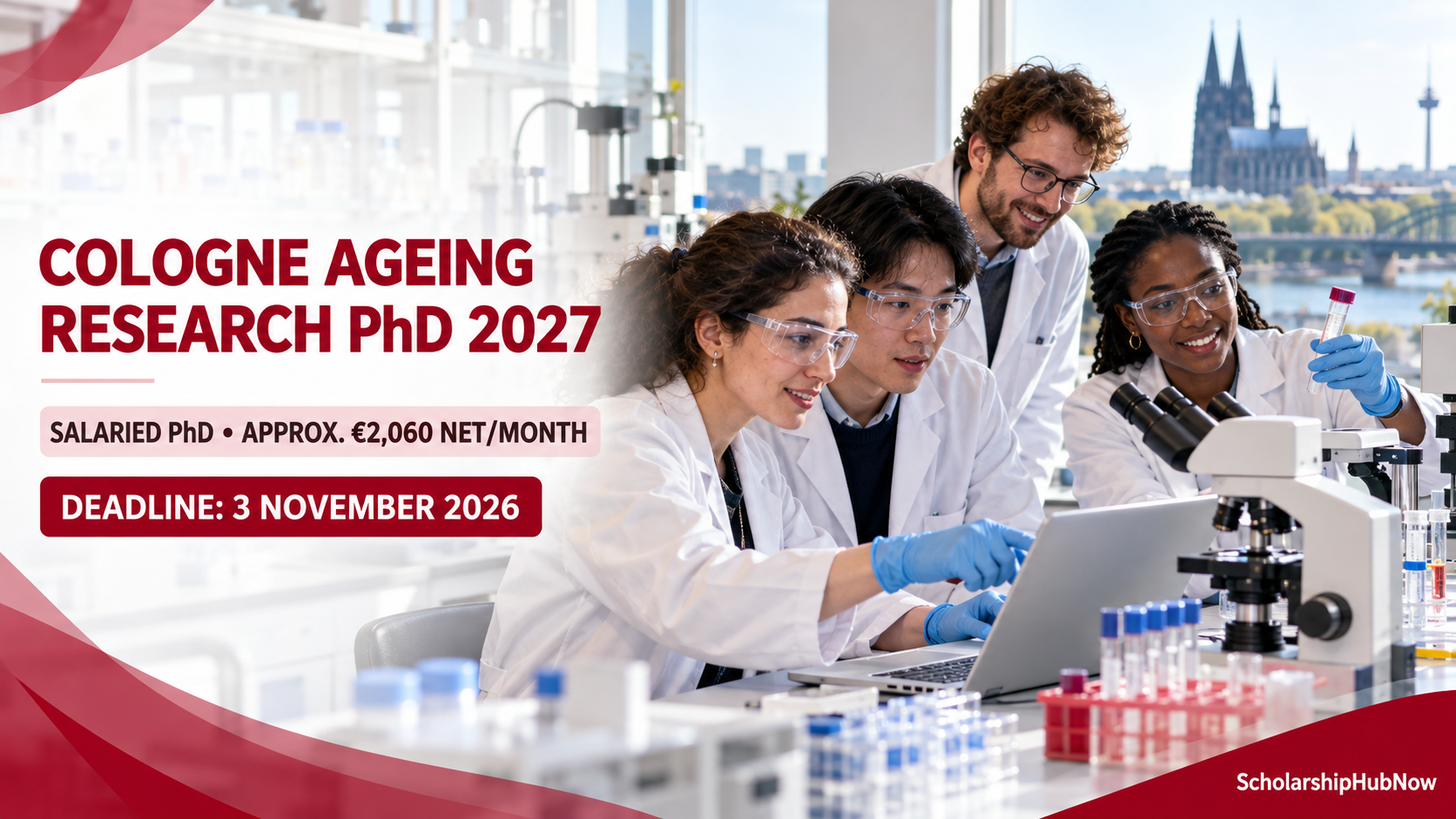
Cologne Ageing Research PhD 2027: Salaried Positions
The Cologne Graduate School of Ageing Research (CGA) PhD 2027 call is open for international applicants seeking salaried doctoral training in ageing and age-related diseases in Germany. Successful candidates receive at least a three-year employment contract with social benefits, generally paid at 65% of the German TV-L E13 scale or through an equivalent Max Planck doctoral-support contract. Applications close on 3 November 2026.
University of Cologne and partner institutes
PhD
Salaried contract with social benefits
3 November 2026
Funding and benefits
All admitted CGA doctoral researchers receive an employment contract for at least three years, including social benefits. The official FAQ states that remuneration is normally based on 65% of TV-L E13, subject to collective-agreement requirements, with an indicated first-year net income of approximately €2,060 per month. Some candidates instead receive an equivalent remunerated doctoral-support contract from the Max Planck Society.
- salary or equivalent remunerated doctoral support for at least three years;
- continued funding by the relevant principal investigator under the same conditions if the project is not completed during the initial contract period;
- no university tuition fees, although a social fee of approximately €356 per semester applies;
- annual travel support of €1,500 for conferences;
- structured scientific and transferable-skills training, mentoring and thesis-advisory meetings;
- free German-language courses and administrative support for international students;
- hotel accommodation and refunded travel expenses for candidates invited to the Cologne recruitment week.
The employing institution may be the University of Cologne, University Hospital Cologne or Max Planck Society, so contractual details can vary. The programme should therefore be described as a salaried funded PhD, not as a fixed scholarship stipend.
Eligibility
Applicants should hold, or be completing before the PhD start date, a master’s degree or equivalent qualification in a relevant life- or natural-science field. Suitable backgrounds include cell and molecular biology, biochemistry, biophysics, bioinformatics, bioengineering, pharmacology, neuroscience, medical biology, translational medicine and related disciplines.
- A master’s degree or equivalent is required by the project start between July and October 2027.
- Medical-degree holders may apply if they have adequate relevant research experience.
- Applicants need strong research experience and academic preparation for the selected laboratories.
- Written and spoken English at C1 level is required.
- No nationality restriction is stated on the official application pages.
English-language requirement
CGA requires C1-level written and spoken English. A formal TOEFL, IELTS or other language certificate is not mandatory. Applicants who do not submit a test result may provide a written statement explaining why they consider themselves fluent, such as previous study completed in English. The structured programme is conducted entirely in English.
Required information and documents
- statements describing previous research experience and motivation for joining CGA;
- a detailed research proposal explaining the applicant’s scientific interests and ideas;
- selection of three possible host laboratories;
- contact details for two referees, including the current or most recent academic supervisor;
- curriculum vitae;
- degree certificates and academic transcripts;
- other supporting documents requested in the portal;
- English-language evidence or a written fluency statement, where applicable.
Documents using non-Latin scripts require an official translation. Referees submit their recommendations directly through the portal; applicants cannot upload recommendation letters on their behalf.
How to apply
- Review the 2027 host-lab proposals. Identify research groups aligned with your experience and scientific interests.
- Prepare the research and motivation statements. Keep them specific to ageing research and the CGA environment.
- Write the research proposal. It should demonstrate scientific reasoning but does not have to become your final doctoral project.
- Select three host groups. Applicants are expected to remain open to working with any of the chosen laboratories.
- Enter two referees. Contact them early; the reference deadline is one week after the application deadline.
- Upload the CV, transcripts, certificates and supporting files. Include provisional documents if the master’s degree is still in progress.
- Submit the online application. Save screenshots or records before final submission because submitted details cannot be changed.
Apply Now on the Official Portal
Application deadline
The official application page gives a deadline of 3 November 2026. It does not state an exact closing time or time zone, so applicants should not assume a midnight cutoff and should submit early. Referee recommendations are due one week after the application deadline. This is the CGA doctoral recruitment deadline, not a separate general university-admission deadline.
Selection process
CGA first checks applications for completeness and eligibility. Faculty then evaluate academic qualifications, research achievements and motivation. Up to 80 candidates are expected to attend online panel interviews from 7–10 December 2026. Approximately 25 candidates may be invited to recruitment week in Cologne from 15–19 February 2027. After laboratory visits and interviews, up to 12 candidates are expected to receive PhD offers. The programme indicates that outcomes should be communicated about two weeks after recruitment week.
Practical applicant tips
- Connect your prior methods and results directly to the scientific questions of the three selected host groups.
- Use the proposal to show how you frame a testable ageing-research question, not merely to summarise literature.
- Give referees sufficient time and confirm that their portal submissions are complete.
- If your master’s thesis is unfinished, clearly separate completed results from planned experiments in the provisional abstract.
- Disclose any permitted AI assistance in the application’s additional-information section, as required by CGA guidance.
Who is this PhD call a strong fit for?
This call is strongest for applicants who can show a clear research trajectory into ageing or age-related disease rather than a generic interest in biomedical science. CGA asks applicants to identify three possible host laboratories and submit a research proposal, while its selection process narrows the pool from up to 80 online interviewees to about 25 recruitment-week invitees and ultimately up to 12 offers.
- Strong fit: applicants with hands-on research experience, a defensible scientific question and methods that connect naturally with several 2027 host labs.
- Needs extra preparation: applicants whose background is relevant but whose proposal is still broad, descriptive or disconnected from the selected laboratories.
- Do not rely on supervisor outreach: CGA explicitly advises applicants not to contact research groups during the online application stage; the written application must stand on its own.
- English readiness matters: the programme requires C1-level written and spoken English, even though a named language-test certificate is not mandatory.
ScholarshipHubNow editorial note: because the programme is highly selective, applicants should use the three-lab choice strategically: pick laboratories that share a coherent scientific theme rather than three unrelated names.
Frequently asked questions
Is the CGA PhD fully funded?
It is a salaried doctoral position with social benefits rather than a conventional scholarship. Funding is provided for at least three years, with continued support promised if the project needs longer under the stated conditions.
Can I apply before finishing my master’s degree?
Yes. You may apply with provisional documents, but the qualifying degree must be completed before the PhD begins between July and October 2027.
Is an English test compulsory?
No named test certificate is compulsory. C1 English is required, and applicants may submit a written fluency explanation instead of a formal test result.
Should applicants contact potential supervisors?
No. CGA advises applicants not to contact research groups during the online application stage in order to preserve a fair selection process.
Are recruitment-week travel costs covered?
The programme states that hotel accommodation will be provided for invited candidates travelling from outside Cologne and that travel expenses will be refunded.
Related verified opportunities
- EMBL International PhD 2027
- IMPRS Intelligent Systems PhD 2027
- IMPRS CoNI PhD 2027
- IMPRS-TP PhD 2027
Official sources
ScholarshipHubNow verified these details against the official CGA pages on 8 October 2026. Applicants should recheck the source pages before submitting.