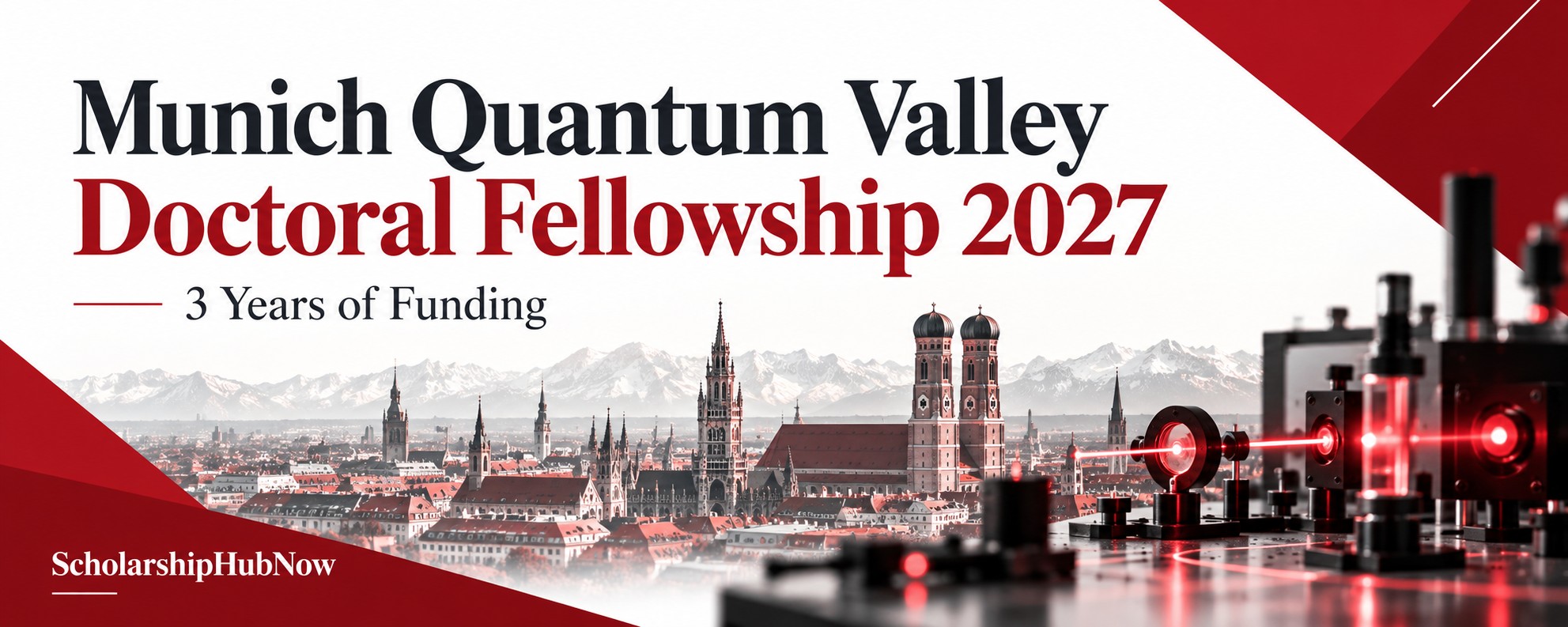
Munich Quantum Valley (MQV) Doctoral Fellowships for 2027 are open until 11 January 2027. The award provides three years of full funding for quantum research in Bavaria. Applicants should complete a master’s or equivalent with very good grades by the end of September 2027 at a university outside Bavaria.
Official sources checked 18 October 2026. No cutoff hour or time zone is stated on the checked MQV call or public portal.
Funding and where you can study
The MQV call describes a personal fellowship allowing a host group at a Bavarian university. Selected fellows must secure a willing supervisor. The call aims for five awards annually; admission is competitive. A universal monthly amount is not published there, so confirm the contract and financial terms before budgeting.
Our interpretation: Portability can be valuable if your research interests span several laboratories. It also means that winning funding and securing a workable supervisory arrangement are connected but distinct tasks. Do not treat an award as permission to arrive without an agreed project and host.
Eligibility and the external-applicant rule
The shared portal restricts applications to external candidates, referring to master’s enrolment or completion in Munich/Bavaria. MQV specifies a degree from outside Bavaria. If you have a mixed-location degree or thesis, obtain an eligibility ruling before investing heavily in the application.
Research spans quantum physics, materials, information theory, computing applications and relevant engineering/computer science. Starts must be no later than 1 December 2027. Selected candidates must commit to a group within one month of results.
Fit guidance: This is not a general-purpose computer-science scholarship. Identify the quantum problem your existing skills help solve. For software work, distinguish a useful implementation from a research question about correctness, performance or the physical constraints of the target system. For experimental work, explain how measurements will distinguish competing explanations.
MQV and MCQST: one portal, different decisions
You may choose MQV, MCQST or both on the common platform; committees make separate decisions. The registration page warns that this choice cannot simply be changed later. Read the labels carefully before registering.
Decision advice: Compare the host geography, academic match and programme terms before selecting a route. Applying to both should be a considered choice, not an assumption that their conditions are interchangeable. Keep separate notes for each programme’s requirements.
Documents and application steps
The MCQST guidance for the shared application lists a photo-free CV, motivation letter, degree certificates/transcripts and relevant award evidence, plus two referees. Treat this as preparation guidance, not proof that the MQV checklist is identical: the MQV-specific fields in the live portal control your submission.
- Check the MQV call and external-applicant definition.
- Review research groups and build a scientifically motivated shortlist.
- Choose your programme option carefully at registration.
- Complete all requested fields and documents; check each upload.
- Submit before the deadline and track the programme’s reference instructions.
MCQST gives 15 January 2027 as its reference deadline. We have not verified a separately stated MQV referee cutoff; do not assume that date transfers automatically. Ask the programme if the portal leaves anything unclear.
Practical safeguard: Create a checklist for your file and a separate one for referees. Agree on an early internal deadline. Record whether an item has merely been requested or has actually been received. A polished motivation letter cannot compensate for an incomplete submission.
Selection and interview preparation
MQV specifies online interviews on 10–12 March 2027, with interview invitations around late February. Its broader process description also uses approximate timing; follow the actual invitation if details change. The companion MCQST process assesses academic preparation, research aptitude, experience, motivation, achievements and references, followed by interviews.
Our preparation advice: Pick one previous project you can defend in detail. Explain your contribution, the assumptions behind the method and a limitation you discovered. Practise answering “what evidence would change your conclusion?” A clear account of a failed approach often shows more understanding than a list of technical keywords.
When comparing hosts, ask about supervision frequency, access to the necessary equipment or computing resources, and how a feasible first-year milestone would be defined. These are questions about working conditions and project viability, not signs of weak enthusiasm.
Frequently asked questions
Is a fixed monthly stipend confirmed?
No universal figure appears in the checked MQV call. Ask for the applicable terms.
Must the host be in Munich?
MQV describes host flexibility across Bavarian universities, subject to a willing supervisor.
Is this a master’s award?
No. This is doctoral funding; the degree requirement must be met for entry.
Should I reuse old IMPRS-QST salary figures?
No. Do not substitute legacy programme terms for a current MQV offer.
Apply Now — Official MQV/MCQST Portal
Compare other German doctoral routes
Compare entry stage, scientific fit and confirmed funding conditions rather than institutional names alone.
Official sources
- MQV Doctoral Fellowship 2027 call
- Shared application portal and external eligibility notice
- MCQST shared-application guidance
ScholarshipHubNow is independent of MQV and MCQST. The providers determine eligibility and selection.