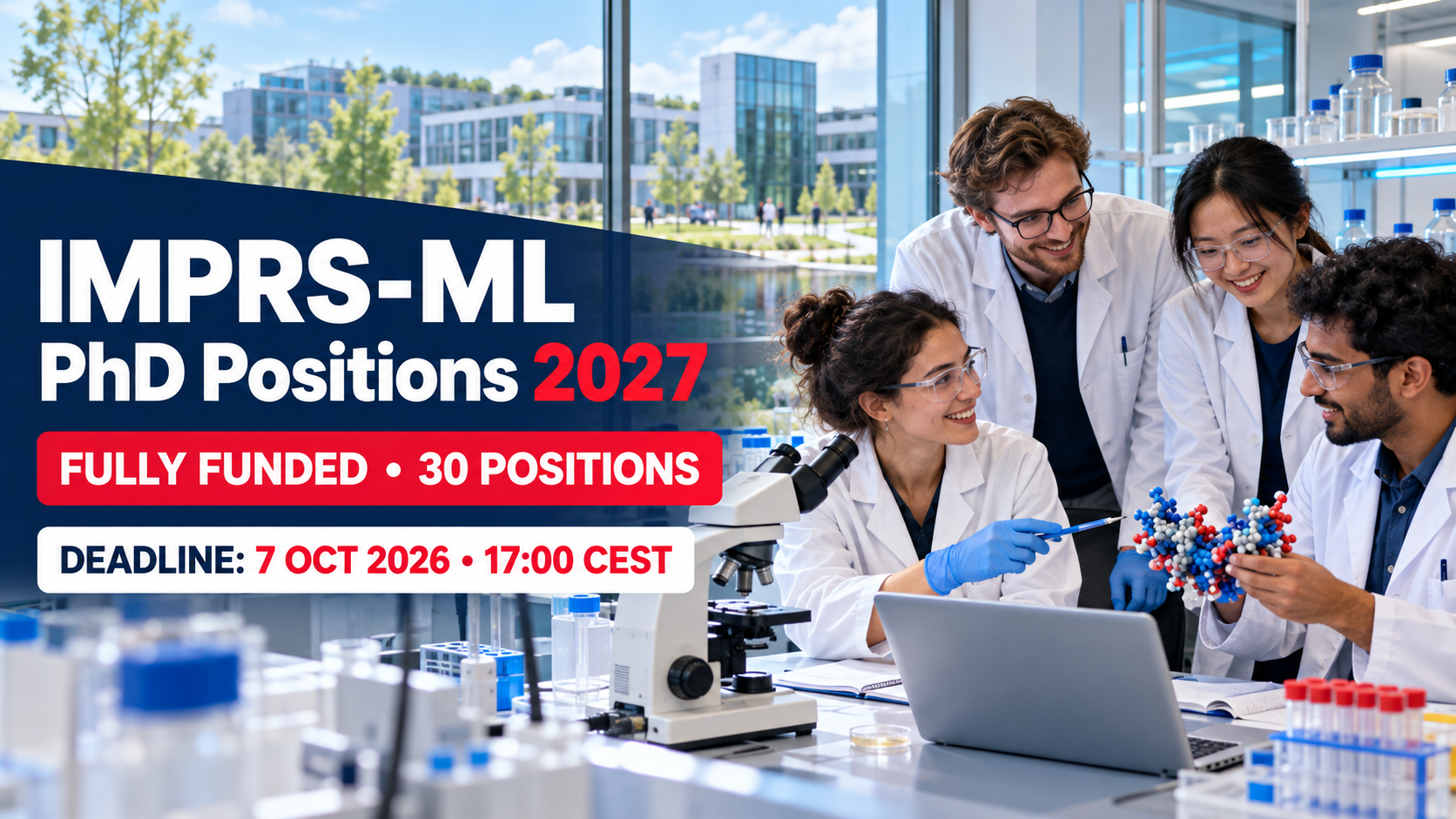
The International Max Planck Research School for Molecules of Life (IMPRS-ML) is accepting applications for 30 fully funded PhD positions in Munich for 2027. Successful candidates normally receive paid TVöD work contracts with health insurance and full social-security coverage; the programme charges no tuition. Complete applications and both reference letters are due by 7 October 2026 at 17:00 CEST.
IMPRS-ML PhD positions 2027: quick facts
| Programme | International Max Planck Research School for Molecules of Life (IMPRS-ML) |
|---|---|
| Location | Munich/Martinsried, Germany |
| Open positions | 30 fully funded PhD positions |
| Fields | Biochemistry, structural and cell biology, biophysics, systems and computational biology, plus related quantitative disciplines |
| Funding | Normally a paid TVöD employment contract; no tuition fees |
| Typical net income | About €2,340 per month, depending on personal circumstances and experience |
| Application fee | The official programme pages do not state an application fee |
| Deadline | 7 October 2026 at 17:00 CEST |
| Start | Between 1 March and 1 October 2027; accepted candidates must start no later than 1 October 2027 |
Funding and benefits
IMPRS-ML describes these as fully funded, paid doctoral positions. Students are typically employed on regular German public-sector TVöD contracts provided by their supervisors. The programme states that these contracts include health insurance and full social-security coverage, including retirement and disability benefits. The typical net income is around €2,340 per month, although the final amount depends on the individual contract, experience and personal tax circumstances.
- No doctoral tuition fees.
- Health insurance and social-security coverage through the employment contract.
- Additional funding for scientific training.
- English-language structured training, mentoring, methodology courses and career development.
- Travel and accommodation are reimbursed for candidates invited to the January 2027 in-person interview week.
Students enrolled at a Munich partner university should still budget for an approximate €100 semester contribution. IMPRS-ML estimates living costs in Munich/Martinsried at roughly €1,300–€2,000 monthly, depending on lifestyle.
Who can apply?
The usual entry qualification is an MSc or equivalent relevant degree. Suitable backgrounds include biology, biochemistry, biophysics, chemistry, computer science, engineering, mathematics, physics and other fields aligned with the recruiting laboratories.
- Applicants normally need a BSc plus MSc totalling about 300 ECTS, or an equivalent five-year integrated degree.
- Eligible four-year first-class BSc honours or MSci degrees from the European Bologna system, the UK, Australia or Canada may also qualify.
- A four-year BSc alone from outside the European Bologna system—including Turkey, the USA, many Asian and African systems—is not accepted.
- Medical, veterinary and medical-student qualifications are not eligible for this PhD programme.
- The qualifying degree may still be in progress when applying, but it must be completed before doctoral enrolment.
- No age limit is stated.
Required documents
- Completed online application form.
- English-language CV, normally two to three pages.
- Degree certificates and transcripts for all completed degrees.
- Provisional transcript for any degree still in progress.
- Two recommendation letters submitted directly through the portal by referees.
- Certified English or German translations plus the originals where required documents use another language.
Recommended but not mandatory additions include an English certificate, evidence of scholarships or prizes, GRE General or GATE results where relevant, a passport copy for international applicants outside the EU, and an optional portrait photograph. Each uploaded file may be no larger than 4 MB.
English-language requirements
English is the programme’s working and teaching language; German is not required. IMPRS-ML expects fluent written and spoken English. Recommended minimum scores are TOEFL iBT 80 with at least 20 in each section, IELTS 6.5 overall and in every section, or Cambridge English at upper B2 (175–179) or higher.
An English test is not an absolute requirement. Applicants who studied in English may apply without a certificate. Other applicants without a test must explain convincingly in the form how their education or experience demonstrates sufficient English.
How to apply
- Confirm that your degree is eligible and review the laboratories recruiting in the 2026/27 round.
- Register in the official IMPRS-ML application portal.
- Invite two senior academic referees; ideally one should be your BSc or MSc thesis supervisor.
- Complete the application form and select up to five recruiting faculty members whose work interests you.
- Upload the required academic documents, CV and translations.
- Make sure both referees submit their letters before the deadline.
- Submit the complete application by 7 October 2026 at 17:00 CEST. Applications cannot be edited after submission.
Deadline and selection timeline
| Application portal opened | 25 August 2026 at 09:00 CEST |
|---|---|
| Application and references deadline | 7 October 2026 at 17:00 CEST |
| Online panel interviews | 23–27 November 2026 |
| Munich interviews and matching | 18–22 January 2027 |
| Acceptance letters | By early February 2027 |
| Latest programme start | 1 October 2027 |
Time-zone note: CEST means Central European Summer Time, UTC+2. Both recommendation letters must already be uploaded before the applicant can submit, so applicants should not wait until the final hours.
Practical applicant notes
- Only groups shown as recruiting may be selected.
- Contacting group leaders before applying is not recommended; explain your research matches in the form instead.
- There is only one recruitment round each year, and late documents are generally not accepted.
- Keep referees informed because the application cannot be submitted before both letters arrive.
- The published €2,340 figure is typical net income, not a guaranteed universal salary.
Frequently asked questions
Is IMPRS-ML fully funded?
Yes. The current call describes paid, fully funded PhD positions with no tuition fees. Students normally receive TVöD work contracts with health insurance and social-security coverage.
Can international students apply?
Yes. IMPRS-ML invites graduates worldwide, subject to its degree-equivalence and subject-background rules.
Is IELTS or TOEFL compulsory?
No. A test is recommended, but applicants educated in English may apply without one, and other applicants can explain alternative evidence of fluency.
Can I apply with a bachelor’s degree?
Only specific four-year first-class honours or equivalent degrees qualify. A four-year bachelor’s degree alone from outside the Bologna system—including Turkey—is not eligible.
Are references due after the application?
No. Both referees must submit their letters before the applicant can submit the final form, and everything is due by 7 October 2026 at 17:00 CEST.
Official sources
- IMPRS-ML application process and 2026/27 timeline
- Official degree eligibility rules
- Required documents and language standards
- Official funding, fee and application FAQs
- DAAD listing for the 30 funded positions
Related opportunities
- DAAD EPOS Scholarship 2027
- Humboldt Research Fellowship 2027
- Cambridge International Scholarship 2027/28
- Hong Kong PhD Fellowship Scheme 2027/28
- University of Melbourne Graduate Research Scholarships 2027
ScholarshipHubNow verified this guide against current IMPRS-ML and DAAD pages on 2 October 2026. Applicants should recheck the official portal before submitting.