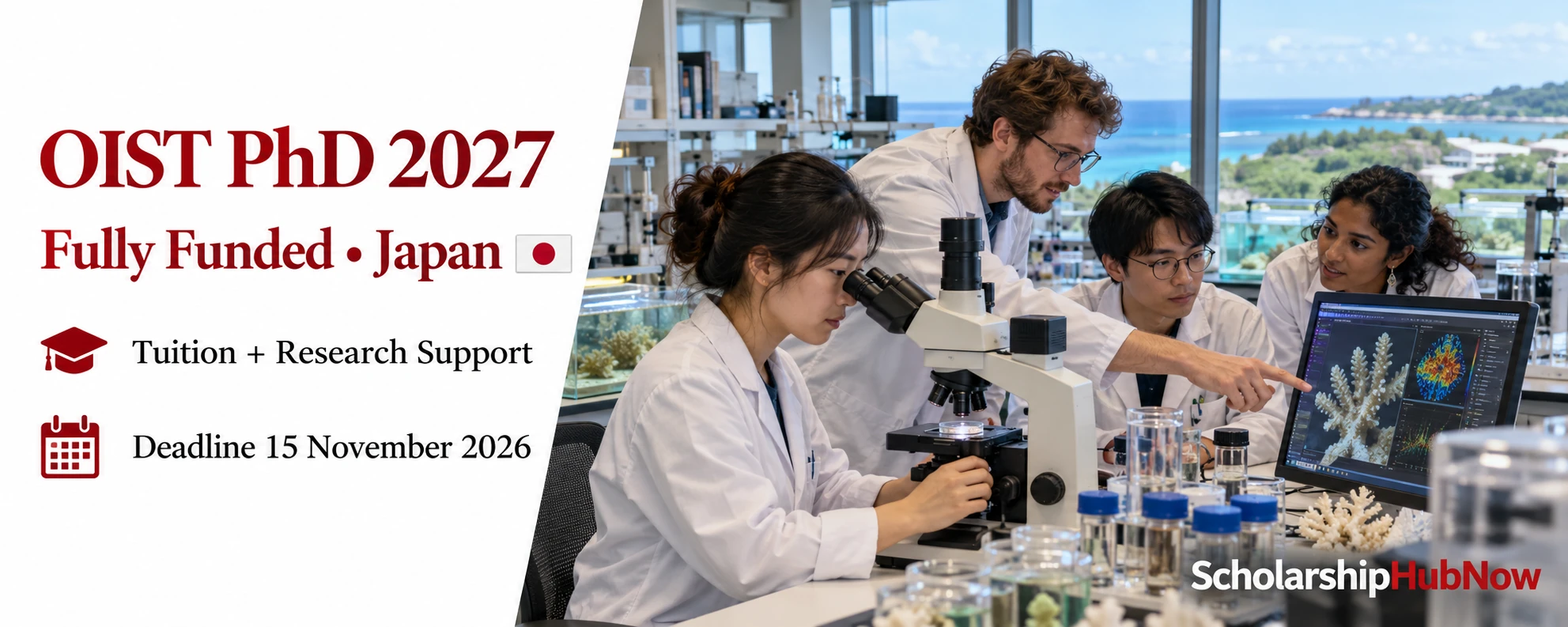
Applications are open for OIST PhD 2027 in Japan. The Okinawa Institute of Science and Technology offers a fully funded, five-year doctoral programme with tuition support, research assistantship funding and subsidised campus housing. The current round closes on 15 November 2026 at 23:59 JST (UTC+9). International applicants can enter after a bachelor’s degree; a master’s is not compulsory.
Okinawa, Japan
Five-year PhD
15 November 2026, 23:59 JST
Funding: what is covered?
OIST’s student-support page describes taxable financial support of approximately ¥2.6 million in the first year, increasing with academic progress to approximately ¥3.6 million. These are indicative annual figures, not a guaranteed tax-free cash payment or a flat rate for every year. The official FAQ confirms full tuition coverage for domestic and international PhD students.
- Subsidised campus accommodation; rent is payable.
- Conference and educational travel budgeted separately.
- Relocation support under OIST’s arrangements.
- Health and wellbeing services, research facilities and visa assistance.
Ask for the current award breakdown before budgeting: distinguish cash remuneration, tuition, taxes and housing charges. Funding does not remove the non-refundable ¥5,000 application fee.
Who should apply?
A completed bachelor’s, master’s or equivalent qualification is required before enrolment. OIST primarily seeks science and engineering applicants, with exceptional consideration of other backgrounds. Its admission policy values curiosity, academic ability, independent thinking, research motivation and effective English communication.
The programme spans areas such as biology, neuroscience, chemistry, physics, mathematics, computational science, ecology and marine science. Students rotate through three units in year one before developing their thesis work. This makes it particularly useful for applicants whose research question sits between disciplines.
Documents and submission requirements
The official application instructions list:
- Academic transcripts and diplomas, or enrolment evidence; English explanations where needed.
- Current CV and statement of purpose.
- Two to five English recommendations from eligible professorial-level referees; lab members/postdocs are ineligible. At least two must arrive before submission.
- Recent TOEFL iBT or IELTS if the qualifying institution’s teaching/examination language was not English.
- Passport or acceptable government identification, plus a recent ID photograph.
The statement page specifies both 800 words and 3,000 English characters. Draft to the tighter character limit and follow the portal’s current validation. GRE and evidence of publications or presentations are optional.
How to apply
- Check research fit. Review OIST units and supervision availability before choosing faculty of interest.
- Create an account on the official application portal.
- Invite referees first. Track their submission status; a complete personal form alone is insufficient.
- Prepare and review uploads. Match research aspirations to specific OIST strengths, then complete payment and submission.
- Prepare for selection. Shortlisted applicants attend online interviews during 18 January–7 February 2027.
Deadline and enrolment dates
The portal is open from 31 July to 15 November 2026. Its stated closing time is 23:59 JST (UTC+9)—equivalent to 14:59 UTC and 17:59 in Türkiye on 15 November. Recommendation letters share the application deadline. Do not interpret the date as midnight in your own country.
The current timetable lists enrolment on 1 May 2027, 1 September 2027 or 1 January 2028. These are round options, not a promise of an unrestricted start-date choice; confirm arrangements with admissions. OIST notes that selection dates may change.
Selection and practical applicant guidance
Selection is merit-based. OIST’s admission policy emphasises the potential to become an independent researcher, alongside academic preparation and communication. There is no written entrance examination. Scientific fit also matters: a strong applicant can be unsuccessful when relevant supervision capacity is unavailable.
ScholarshipHubNow’s interpretation: the strongest application connects a research problem, evidence of the applicant’s contribution and a realistic reason OIST is the right environment. Describe what you personally designed, measured, coded or interpreted in earlier projects. Explain one setback and how you responded; this can show scientific judgement more clearly than a list of techniques.
Build a short comparison of several relevant units for your own preparation: question, methods, recent work and capacity. Use it to explain coherent interests rather than inserting unrelated professor names. Because rotations are central to the programme, intellectual flexibility should support a clear direction.
Choose referees who can describe your research potential with specific examples. Give them a concise project summary and an earlier personal target date. OIST advises applicants against contacting faculty simply to seek pre-application approval. Admission is to the programme, with laboratory matching later.
For interviews, practise explaining a previous project to someone outside your specialty: question, design, result, limitation and next experiment. If you still need foundational research experience, consider a research internship before committing to doctoral study.
Other funded research routes
- KAUST PhD funding guide (Spring 2027 is closed; check the separate Fall route).
- Hong Kong PhD Fellowship Scheme for applicants comparing Asian doctoral destinations.
- Max Planck Schools for interdisciplinary graduate research in Germany.
- KAUST VSRP internships for building research experience.
Each route has separate eligibility, timing and funding conditions; check its current official application window.
Frequently asked questions
Is this a separate OIST scholarship application?
No. Applicants apply for doctoral admission; OIST states that all its PhD students receive funding, regardless of nationality. External scholarships are not a prerequisite.
Is the accommodation free?
No. Campus housing is subsidised. Include rent and other personal costs in your budget.
Can I apply without a master’s?
Yes, if you meet the bachelor’s-equivalent qualification and admission requirements before enrolment.
Is there a minimum English test score?
The current instructions set no minimum, but a qualifying TOEFL/IELTS report is required when the language condition applies. English communication remains part of academic readiness.
Can I submit while references are pending?
You need at least two received PhD recommendation letters before submitting. Arrange them well ahead of the closing date.
Official sources and Apply Now
- Current application window
- Application requirements and timetable
- Official FAQ: references, tuition, relocation and English
- Funding and student support
- Programme structure
Apply Now on the Official OIST Portal
Official information checked on 11 October 2026. Recheck the OIST instructions and portal before submitting.