Illinois Geography & GIS Funding 2027: Master’s and PhD
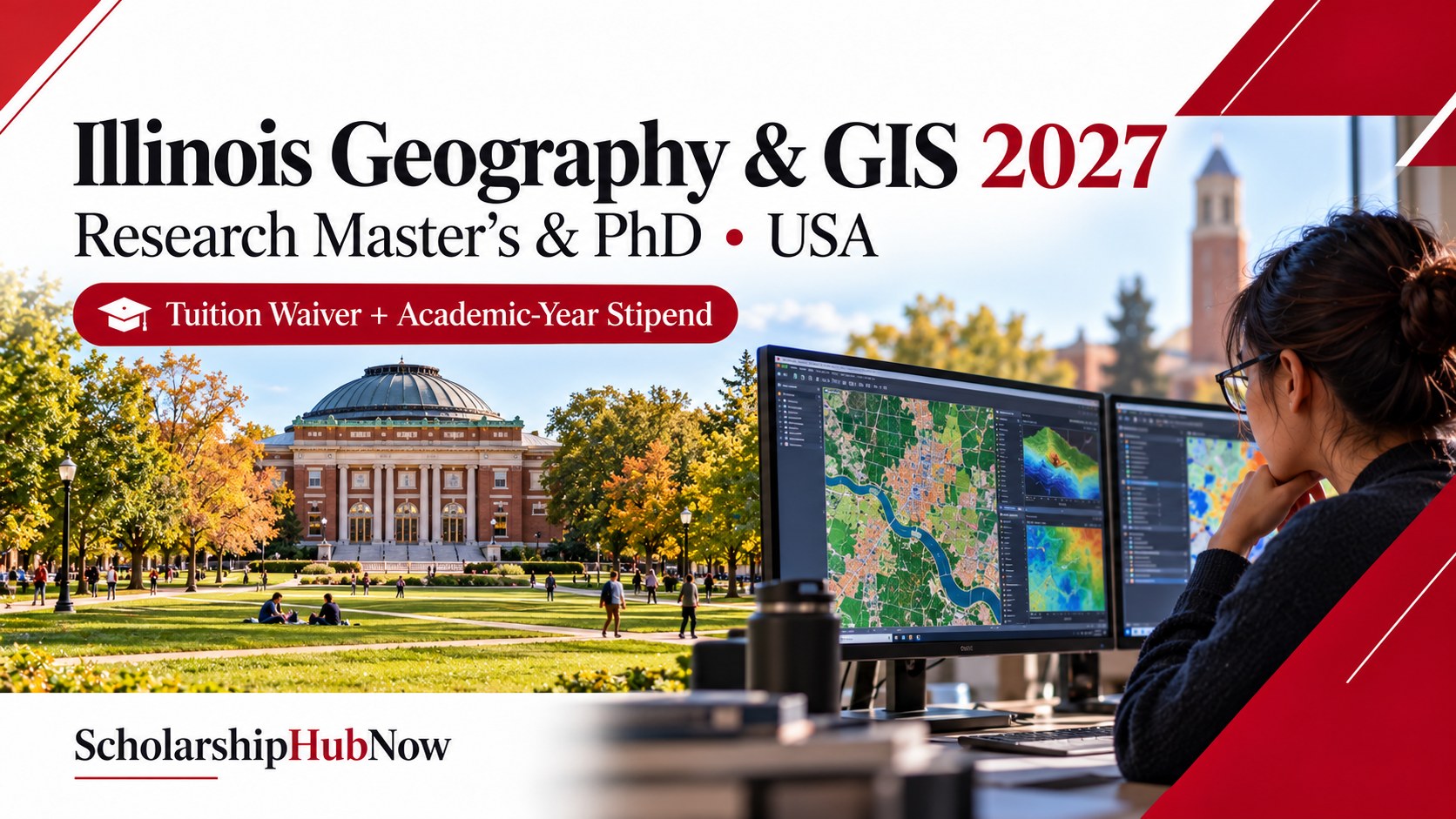
Illinois Geography and GIS funding for Fall 2027 is open to applicants for research-based master’s and PhD study. Admitted students are offered assistantship or fellowship funding with an academic-year monthly stipend and a full tuition waiver covering most fees. Apply by 15 December 2026. International applicants are considered on the same admission and funding basis as domestic applicants.
Official sources checked on 21 October 2026. This guide concerns on-campus research degrees; do not assume the same funding applies to professional or online programmes.
Illinois Geography & GIS funding 2027: overview
| University | University of Illinois Urbana-Champaign, USA |
|---|---|
| Department | Geography & Geographic Information Science (GGIS) |
| Intake | Fall 2027 |
| Research degrees | MA, MS and PhD in Geography |
| Application deadline | 15 December 2026 |
| Funding route | Teaching/research assistantship or, for some PhD students, pre-doctoral fellowship |
| Separate TA/RA application | Not required |
What does the funding cover?
The current departmental admissions page confirms an academic-year monthly stipend and waiver of tuition and most fees. It does not establish one universal Fall 2027 stipend amount, summer guarantee or fixed number of funded years.
The assistantship information explains that teaching support is competitive and involves duties such as grading and discussion or laboratory sessions. Research assistant availability and required training depend on faculty projects.
Our funding assessment: this is a substantial funded research route, but “most fees” should be read carefully. Before accepting, request a written breakdown of stipend months, remaining fees, insurance charges, renewal conditions and summer support. Compare the amount available after deductions with your housing and living budget. Do not calculate a twelve-month income by multiplying an academic-year stipend without confirming summer coverage.
Who should consider applying?
The department’s research areas span geographic information science; river, watershed and landscape dynamics; and space, society and the built environment. Selection considers academic achievement and potential alongside the fit between an applicant’s goals and core faculty expertise.
The Graduate College normally requires a recognised bachelor’s degree or equivalent and at least a 3.0/4.0-equivalent admission GPA, calculated using its rules. Programmes may set higher requirements. International applicants must check country-specific academic and English requirements on the official minimum requirements page.
The currently published 2026–27 Geography PhD catalogue expects a strong geography or related background, at least 3.0 in the undergraduate major, and generally at least 3.5 in previous graduate work. Treat this as current guidance and confirm any Fall 2027 changes. Its degree structure includes routes entering with an approved bachelor’s or master’s degree.
Applicant-fit guidance: this route is worth investigating if you can turn an environmental, social or spatial problem into a clear research question. For example, experience with satellite imagery could support a proposal about land-use change, while field hydrology could support a watershed question. These are examples of how to present transferable skills, not advertised vacancies or promises of supervisor availability.
Documents to prepare
- An academic statement of purpose, maximum 1,000 words.
- Personal-statement responses, maximum 250 words each.
- Three recommendation letters.
- Unofficial transcripts and degree certification, including the transcript key.
- English-language evidence where required.
Follow the live application prompts for any additional materials. The department says it does not accept third-party credential evaluations such as WES or ECE. Official credentials are required after admission and enrolment.
The Graduate College application instructions distinguish required and optional personal-statement questions and explain uploads. They also require statements to represent the applicant’s own experience and judgment; AI should not generate substantive portions of them.
How to apply, step by step
- Choose the research degree. Review the department’s degree options and avoid selecting a professional or online course by mistake.
- Identify faculty fit. Read recent work by potential core faculty advisers. Contacting an adviser beforehand is welcome but is not compulsory.
- Write a focused statement. Explain your research question, relevant preparation and why the department can support that work.
- Arrange recommendations early. Give referees your draft goals and enough time to discuss your research potential.
- Submit through the Graduate College portal. Use the portal linked from the official departmental application page and select Fall 2027.
- Pay and verify completion. International applicants should budget the published US$90 application fee; the department says no international fee waivers are available.
The dated Fall 2027 announcement confirms applications are open, the 15 December 2026 deadline, and that GRE scores are neither required nor considered. It also confirms there is no spring intake for the research MA/MS/PhD.
Deadline precision: the departmental pages checked state the date but do not specify a submission time or time zone. Check the portal and ask the programme if needed; do not assume midnight in your home country.
How to make the application persuasive
Our advice: build your statement around one manageable question rather than a list of interests. Explain the data you would need, an appropriate method, a limitation you would test and the faculty expertise that makes the work feasible. Use one concrete example from previous research to show how you solved a problem or revised a method.
For GIS applicants, a map alone is less informative than an explanation of data quality, spatial scale and validation. For physical geography applicants, connect field observations to a testable process. For human geography applicants, explain the conceptual framework and how evidence would be collected ethically. These suggestions are editorial guidance, not an official scoring rubric.
Frequently asked questions
Is this a separate scholarship competition?
No separate TA/RA application is required. The completed research-degree application is considered for admission and funding.
Can international students receive funding?
Yes. The department states that admission and funding offers are the same for domestic and international applicants. Teaching appointments also require the relevant spoken-English eligibility.
Is every cost and summer month covered?
The verified promise is an academic-year stipend and waiver of tuition and most fees. Confirm the remaining costs and summer arrangements in the offer.
Do I need a master’s before a PhD?
The current catalogue includes a bachelor’s-entry route. Confirm your academic preparation and proposed route with the department.
Should I email all my documents to faculty?
Submit the formal application through the portal. A short research-fit enquiry serves a different purpose from submitting application credentials.
Apply now and compare funded options
Apply Now — Illinois GGIS official application instructions and portal
For broader planning, compare our guides to Notre Dame’s funded Peace Studies PhD, DAAD STEM master’s funding and UQ graduate research funding. Compare subject fit and funding terms before choosing where to invest application time.
Official sources
- GGIS application requirements and funding
- Fall 2027 call for applications
- Assistantships and fellowships
- Research degrees and selection factors
- Graduate College minimum requirements
- Current Geography PhD catalogue
- Graduate application instructions