The NSF Graduate Research Fellowship Program 2027 is now open for eligible U.S. citizens, nationals and permanent residents preparing for research-based master’s or doctoral study in STEM. Each fellowship provides three funded years within a five-year award period, with a US$37,000 annual stipend and a US$16,000 annual cost-of-education allowance paid to the institution in place of tuition and mandatory fees.
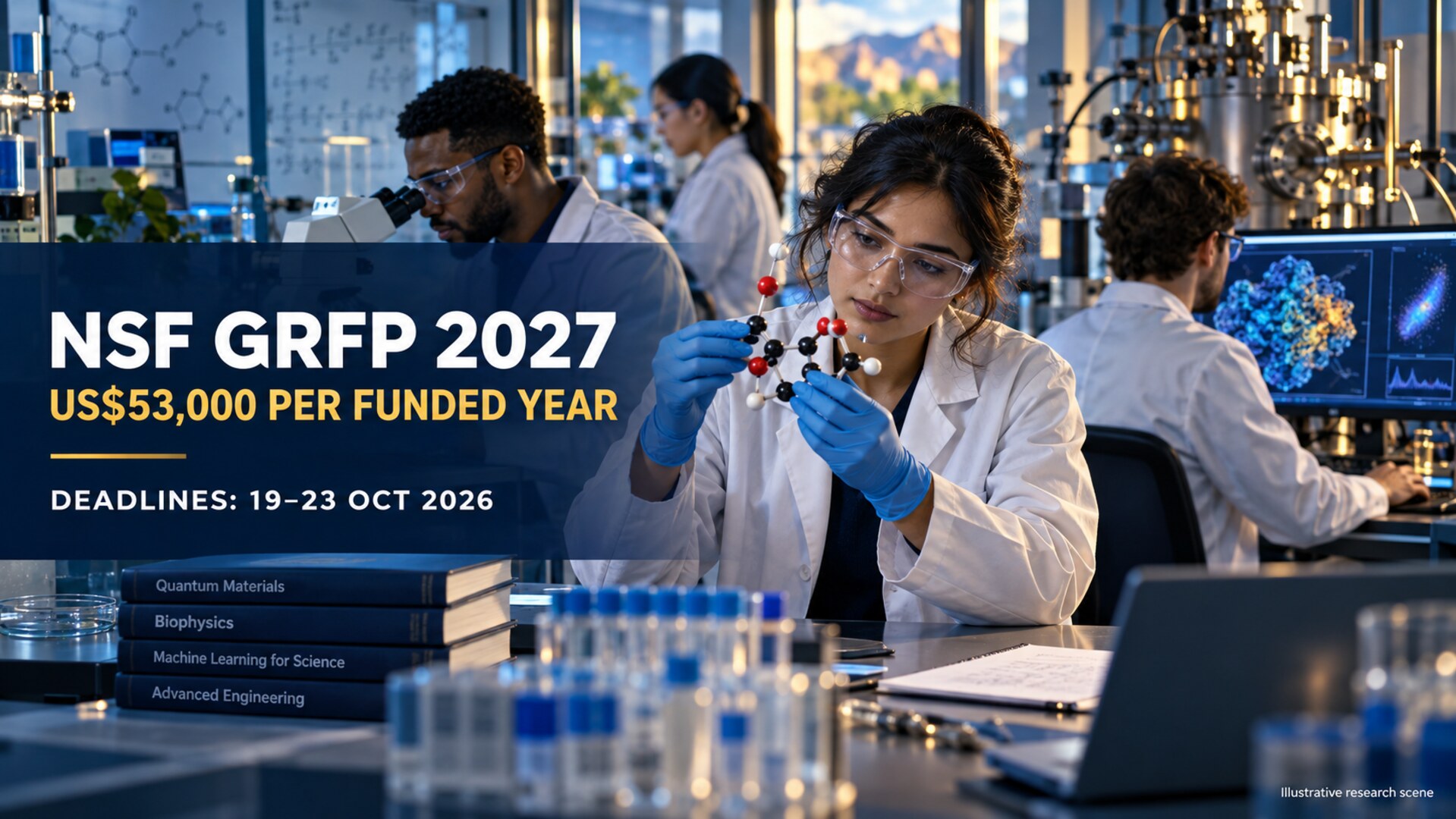
Funding: US$53,000 per funded year for three years
Study level: Research-based master’s and PhD
Host institutions: Eligible accredited nonprofit U.S. institutions
Application fee: No fee is stated by NSF
Reference deadline: 16 October 2026, 8:00 p.m. Eastern Time
Application deadline: 19–23 October 2026, 8:00 p.m. Eastern Time, depending on field
What does the NSF GRFP 2027 cover?
The five-year fellowship includes three years of financial support. For each funded year, NSF provides a US$37,000 stipend to the fellow and a US$16,000 cost-of-education allowance to the institution. NSF states that the allowance covers tuition and mandatory fees, leaving no tuition or mandatory-fee cost to the student during a funded year. There is no post-graduate service requirement, and the award is portable between eligible institutions under programme rules.
Who is eligible?
You must meet every official condition by your application deadline:
- Be a U.S. citizen, U.S. national or permanent resident when submitting.
- Plan to enroll, or already be enrolled full time, in an eligible research-based master’s or doctoral programme in an NSF-supported STEM field.
- Be an undergraduate senior, a bachelor’s graduate with no graduate-degree enrollment, a qualifying joint bachelor’s-master’s student, or a first-year graduate student with less than one academic year completed.
- Not have previously accepted an NSF Graduate Research Fellowship.
- Not hold a master’s, doctoral or terminal degree and not be a current NSF employee.
International students on visas are not eligible. Professional practice degrees such as MBA, MPH, JD, MD, DVM and DDS, and joint professional-research degrees such as MD/PhD, are excluded under the published rules.
2027 deadlines by field
All times below are 8:00 p.m. Eastern Time. Your selected Major Field of Study controls the deadline.
- 16 October 2026: all reference letters due.
- 19 October 2026: Life Sciences.
- 20 October 2026: Computer and Information Science and Engineering; Materials Research; Psychology; Social Sciences.
- 22 October 2026: Engineering.
- 23 October 2026: Chemistry; Geosciences; Mathematical Sciences; Physics and Astronomy.
Documents and application components
- Research.gov account and completed personal-information sections.
- Education, employment, honors, publications, presentations and other experience.
- Official undergraduate transcript in PDF format; a graduate transcript may be unofficial only in the limited first-term situation described by NSF.
- Three reference-writer names and contact details; at least two letters must reach NSF. Up to five may be requested, with the top three received considered.
- Personal, Relevant Background and Future Goals Statement, maximum three pages.
- Graduate Research Plan Statement, maximum two pages.
Both statements must use the headings Intellectual Merit and Broader Impacts and follow NSF’s strict page, margin, font, spacing and PDF rules. No English-language test is listed because this is a fellowship application rather than university admission; applicants must separately satisfy their chosen institution’s admission requirements.
How to apply
- Read the current NSF 2027 Notice of Funding Opportunity and complete the official eligibility check.
- Create or sign in to a Research.gov account and open the GRFP Application Module.
- Select the correct application level and Major Field of Study.
- Enter your academic and professional history and upload the required transcript.
- Add reference writers early so they can submit by 16 October 2026 at 8:00 p.m. ET.
- Prepare both statements with the official templates and formatting rules.
- Review every section and submit by the deadline assigned to your field.
Official sources
- NSF GRFP 2027 overview, funding and deadlines
- Official applicant eligibility
- Official application components and instructions
- NSF 26-526 programme notice
Frequently asked questions
Is NSF GRFP fully funded?
It provides a US$37,000 stipend and a US$16,000 education allowance for each of three funded years. NSF says the allowance replaces tuition and mandatory fees during supported years.
Can international students apply?
No. Applicants must be U.S. citizens, U.S. nationals or permanent residents at submission.
Can first-year graduate students apply?
Yes, if they are in their first graduate degree programme and have completed less than one academic year by the application deadline, subject to the complete rules.
Is there one common deadline?
No. References are due 16 October 2026, while applications are due from 19 to 23 October 2026 according to the selected Major Field of Study. Every stated deadline is 8:00 p.m. Eastern Time.
Related opportunities
ScholarshipHubNow summarizes official information for applicants. Always recheck the NSF pages before submitting.