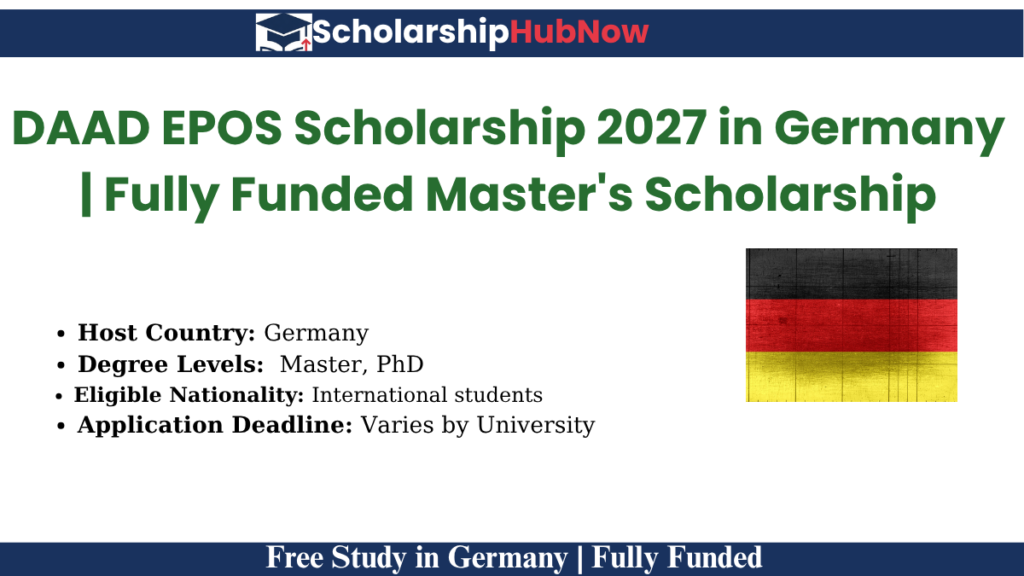
The DAAD In-Country/In-Region Scholarships 2027 are open for selected development-related Master’s programmes in Sub-Saharan Africa. The award generally covers tuition fees, a monthly scholarship, study and research support, and thesis-printing costs. In-Region scholars also receive travel support and health insurance. The official DAAD deadline is 12 November 2026 at 24:00 CET, but each host university may set a separate admission deadline.
Full-time Master’s · up to two years
Tuition + monthly award + study support
12 November 2026 · 24:00 CET

DAAD Africa Scholarships 2027: quick facts
| Provider | German Academic Exchange Service (DAAD), supported by Germany’s Federal Ministry for Economic Cooperation and Development |
|---|---|
| Programme | In-Country/In-Region Programme Sub-Saharan Africa |
| Degree | Selected development-related Master’s programmes |
| Start period | August–December 2027 for the currently listed calls |
| Duration | Regular programme length, generally up to two years |
| Deadline | 12 November 2026 at 24:00 Central European Time (CET) |
| Application route | DAAD Portal plus a separate admission application to the selected host institution |
What the scholarship covers
DAAD lists a substantial funding package, but it does not publish one universal cash amount for every host and country. Applicants should use the individual call PDF for the exact rate. The general package includes:
- Tuition fees, normally paid directly to the host university or institution.
- A monthly scholarship for living costs.
- A study and research allowance.
- A printing allowance for the final thesis.
- For In-Region scholars only, a travel allowance and health-insurance support.
DAAD may offer additional training and, in suitable cases, the possibility of applying separately for a two-to-six-month research stay in Germany. These extras are not automatic parts of every initial award.
Which Master’s programmes are open?
The live DAAD database currently lists programmes in Burkina Faso, Ghana, Ethiopia, Kenya, Rwanda, Tanzania, Uganda and Malawi. Examples include Water and Environmental Engineering at 2iE, Seed Science and Technology and Molecular Cell Biology of Infectious Diseases at the University of Ghana, Environmental Health at Jimma University and MUBAS, Plant Breeding at Chuka University, Electrical Power Systems at the University of Rwanda, Geomatics at Ardhi University, and Climate Change and Disaster Management at Busitema University.
Do not choose a university merely because it participates in another DAAD cycle. Only the programmes marked as currently open in the official database are valid for this deadline; additional programmes may be published later.
Who is eligible?
General eligibility for the current Master’s competition includes:
- Nationality or permanent residence in a Sub-Saharan African country.
- A completed three- or four-year Bachelor’s degree, normally with above-average results of at least Second Class Upper Division or equivalent.
- The most recent university degree completed no more than six years before application.
- Strong motivation and commitment to a career connected with teaching, research or development in Sub-Saharan Africa.
- Suitable knowledge of the programme’s language of instruction, usually English.
- Eligibility for admission to one of the specifically supported full-time Master’s programmes.
DAAD especially encourages women, applicants with recognised refugee status, and candidates from marginalised or less privileged regions or groups. There is no general age cap, but the six-year recency rule for the last degree still applies. Online, part-time and short courses are not funded under this scheme.
In-Country vs In-Region: which route fits?
- In-Country: you study in your home country, or in a country where you already hold residence status.
- In-Region: you study in another Sub-Saharan African country where you do not hold residence status.
In-Region applicants receive the broader standard package because DAAD lists travel and health-insurance support for that route. Your choice must still match the eligibility wording in the individual programme call.
Documents to prepare
- Completed DAAD online application form.
- Tabular CV, normally no more than three pages.
- A 300–1,000-word motivation letter covering personal, social and academic reasons, plus the proposed Master’s project or course plan.
- A signed recommendation from a university teacher or lecturer, issued within the previous year.
- Proof of the required language skills.
- Degree certificates and full transcripts for all study years, including the grading scale.
- Passport or national identity document.
- English or German translations for documents issued in another language.
An admission letter may usually be submitted later, before the scholarship begins, but the university may require extra documents. The official FAQ warns that missing final transcripts or the completed degree certificate makes the scholarship application incomplete.
How to apply
- Open the current programme list. Select one of the degree programmes explicitly marked open in the DAAD scholarship database.
- Read its individual call PDF. Confirm nationality rules, course requirements, funding amounts, host admission steps and any earlier local deadline.
- Apply to the host institution. Follow that university’s admission procedure; do not send the university application to DAAD.
- Use the correct DAAD Portal link. The portal link is programme-specific. Applications sent by email, post or through the wrong link are formally rejected.
- Upload every required document. Include translations and ensure the referee form is current, signed and complete.
- Submit before 24:00 CET on 12 November 2026. A host admission deadline may be earlier, so treat the earlier date as controlling.
How candidates are selected
DAAD first checks the scholarship file for formal completeness while the host institution evaluates admission. Only complete, shortlisted applications proceed to the final selection committee. DAAD’s published criteria focus on:
- Academic achievement, progress and relevant experience.
- Knowledge of the teaching or working language.
- The quality, preparation and feasibility of the study project.
- How the programme fits the applicant’s academic and career path.
- Academic, professional and personal motivation.
- Future development potential and extracurricular or social commitment.
Host institutions may interview candidates for admission. DAAD says it does not currently interview Master’s scholarship applicants, though programme-specific procedures can differ.
Practical applicant guidance
- Build two applications in parallel. The scholarship and university admission files travel through different systems and both must succeed.
- Name the development problem. Show how the chosen degree addresses a concrete need in your country or region and how you will use the training afterward.
- Tailor the motivation letter. A generic DAAD essay is weaker than one connecting your prior work, the exact curriculum and a realistic post-degree contribution.
- Check degree recognition early. In-Region candidates should confirm that the host country and university recognise their Bachelor’s qualification.
- Do not guess the stipend amount. Funding rates vary by programme and country; rely on the PDF linked beside your chosen degree.
Frequently asked questions
Is the DAAD In-Country/In-Region Scholarship fully funded?
It covers the major study costs DAAD specifies: tuition, a monthly scholarship, study/research support and thesis printing. In-Region scholars also receive travel and health-insurance support. Exact amounts vary by call.
Can refugees apply?
Yes. DAAD encourages applicants with recognised refugee status, provided they are citizens of a Sub-Saharan African country and meet the formal requirements.
Do I need admission before applying?
Not necessarily. DAAD instructs candidates to apply for admission and funding at the same time; the admission letter can generally follow before final scholarship selection. Check the individual call.
Can I apply to an unlisted programme?
No. Funding is restricted to the programmes currently listed in the official DAAD database for this competition.
What time does the portal close?
The DAAD applicant guidance says the portal closes at 24:00 CET on the final day, 12 November 2026. A host institution may use a different, earlier admission deadline.
Related scholarship guides
- DAAD Master’s Scholarships 2027/28
- DAAD STEM Scholarship 2027/28
- DAAD Hilde Domin Programme 2027/28
- Commonwealth Master’s Scholarships 2027/28
Official sources
- DAAD programme overview and funding
- DAAD scholarship database: current programmes and deadline
- DAAD applicant requirements, documents and submission guidance
- DAAD applicant FAQ and selection criteria
Funding amounts, admission rules and local deadlines differ by host. Read the individual call PDF for your chosen course before submitting.