The Eric Bleumink Fellowship provides comprehensive Master’s funding at the University of Groningen through university nomination, with no direct scholarship application. For September 2027 planning, complete your Master’s admission application before 1 December 2026 so it can be assessed in time. Groningen confirms that applications for the 2027/28 academic year opened on 1 October 2026.
The fellowship’s current official guidance covers tuition, international travel, living costs, books and health insurance for eligible one- or two-year September-entry programmes. Admission is necessary for consideration, but does not guarantee nomination.
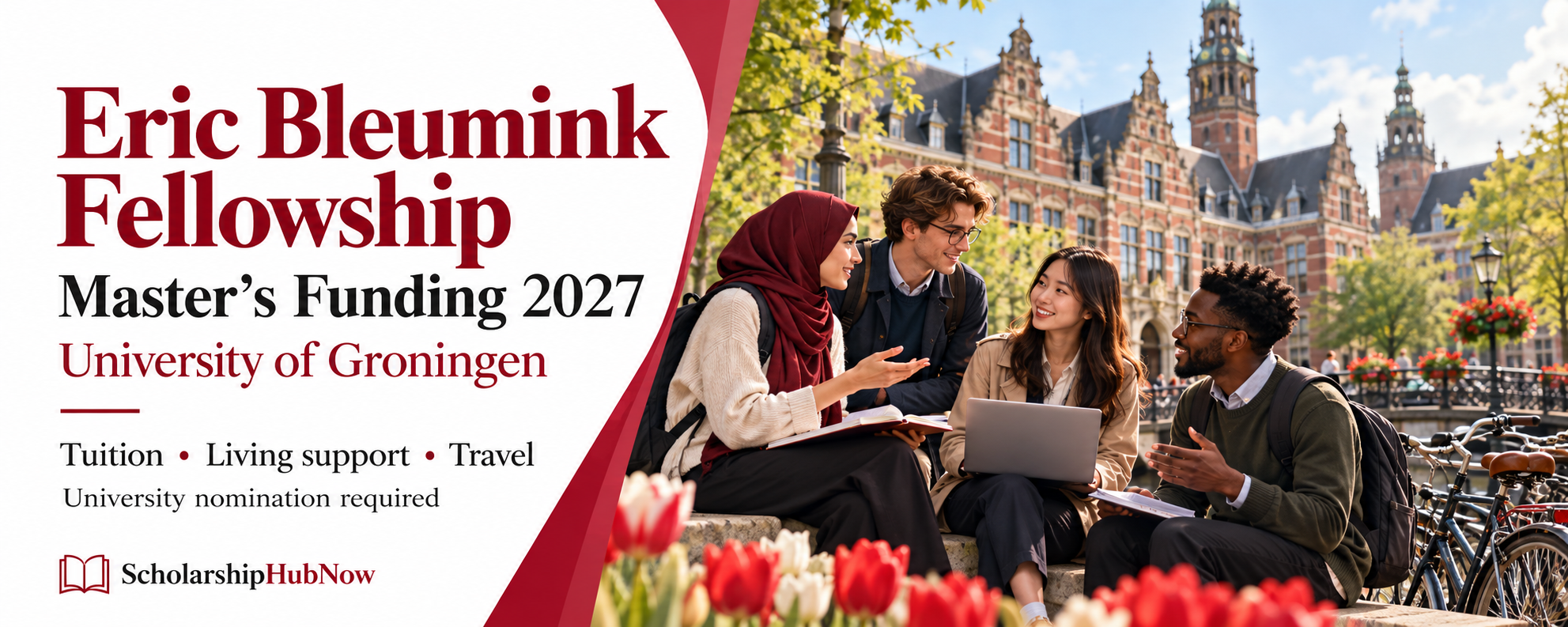
Eric Bleumink Fellowship 2027: key facts
| Host | University of Groningen, Netherlands |
|---|---|
| Level | Master’s: MSc, MA or LL.M. |
| Route | University nomination following Master’s admission |
| Planning date | Complete admission application before 1 December 2026 for September 2027 planning |
| Cutoff time | No time or time zone stated in the fellowship guidance |
How the 2027 dates were determined: Groningen’s 2027/28 application-opening notice confirms the current admission cycle. The fellowship pages give an annual “before 1 December” admission-completion instruction and require an admission offer before February. Applying those annual dates to September 2027 gives December 2026 and February 2027. The university has not published a separate, year-labelled 2027 scholarship call on those pages.
Who is eligible?
Candidates need an eligible nationality, excellent undergraduate results and academic performance, programme-level English proficiency, availability for the full course, and no other means to finance the study. They must also be in a position to arrange health insurance and obtain provisional or unconditional admission before February.
The official country list includes, among others, Bangladesh, Ethiopia, Ghana, India, Kenya, Nepal, Nigeria, Pakistan, Uganda and Vietnam. This is not a worldwide award: verify your nationality against the full official list and the linked rules before paying an admission fee. The scheme gives preference to least-developed countries under its published regulations.
What funding is covered?
The funding scope is substantial, but do not assume every expense is reimbursed. The currently linked rules, updated November 2024, describe economy travel, tuition, insurance and allowances. They exclude family support, clothing allowance and excess baggage, and expect recipients to return home after the funded training.
Those regulations contain allowance figures, but this guide does not treat a 2024 figure as a newly confirmed 2027 payment rate. If nominated, check the award letter’s amounts, payment dates, travel arrangements and housing conditions before committing to expenditure.
Documents: prepare the admission file first
There is no general separate EBF form to submit unsolicited. Groningen’s Master’s document guidance requires qualification evidence, academic transcripts and, where applicable, an expected-graduation statement and list of unfinished courses. Documents must be in English or Dutch, with translations as needed.
English-test evidence and additional material depend on the programme. Some courses request a CV, motivation letter, references, course descriptions or writing sample; others do not. Follow the relevant checklist rather than uploading a generic scholarship pack. Plain copies can support initial assessment, while certified copies are needed for final admission.
How to pursue consideration
- Select a suitable September-entry Master’s. Use the official programme directory to match your previous study with entry requirements.
- Check nationality and funding eligibility. Confirm that your country appears in the official EBF guidance.
- Start admission in Studielink. Follow Groningen’s registration instructions and any applicable application-fee requirements.
- Complete the Progress Portal file. Activate your university account and upload all required evidence. Studielink registration alone is insufficient for assessment of an international diploma.
- Finish before the December planning date. Leave time to correct the file and obtain an offer before February.
- Wait for university nomination. The admissions office and faculty boards identify candidates. Do not email an unsolicited scholarship application.
The Progress Portal instructions explain how to check missing steps and documents. Its checklist and fee status matter: an incomplete application may not reach the admissions office for evaluation.
How candidates are selected
The nomination guidance says nominees are informed before 1 February; applicants who receive no nomination notice are not selected as nominees.
The regulations consider how the education would strengthen academic capacity in the home country, prospects for sustained institutional links, motivation and diversity across disciplines and regions. They also address disclosure of other funding requests and restrictions on simultaneous Groningen scholarships. Nomination and final award are distinct steps.
Practical applicant-fit guidance
ScholarshipHubNow’s interpretation: this is best approached as a strong academic admission application with a realistic development purpose. A funding need alone is not enough. Show that you meet the chosen programme’s prerequisites and can explain what its training would enable you to do.
Where a motivation letter is requested, connect three pieces of evidence: your previous preparation, the skills the course would add, and a specific problem you want to address after study. For example, an environmental applicant could explain how an existing project exposed a methods gap and how a particular module would help close it. Use an example you can substantiate.
Ask referees for concrete evidence of analytical ability and academic achievement when references are required. An official class rank, a demanding thesis or a documented research contribution is more useful than repeated claims that you are passionate.
Keep two plans. The first is the nomination route; the second is what you will do if you are admitted without funding. Do not accept financial obligations based on the expectation that nomination will follow. Before paying a fee, assess both admission fit and scholarship eligibility.
Other Master’s funding to compare
- Radboud Scholarship 2027/28: Tuition Reduced for International Students
- EPFL Master Excellence Fellowship 2027: CHF 10,000 Per Semester
- Cambridge Mastercard Foundation Scholars 2027 | Fully Funded Master’s
- Erasmus Mundus PlantHealth 2027–2029: €1,400/Month
Compare coverage and eligibility carefully: a tuition reduction, a fellowship payment and comprehensive scholarship funding leave different personal funding gaps.
Frequently asked questions
Can I apply directly for the Eric Bleumink Fellowship?
No. Apply for Master’s admission; the university nominates suitable candidates.
Is 1 December a separate scholarship deadline?
No. The official instruction is to complete the Master’s admission application before that date to allow processing. It gives no precise cutoff time.
Does admission guarantee funding?
No. An offer makes consideration possible; nomination and award remain competitive.
Can I use the fellowship for a February start?
The published guidance covers September-entry programmes.
Are applicants from every country eligible?
No. Check the official nationality list and nomination preferences.
Official sources and Apply Now
- Official fellowship: funding and eligibility
- Official nomination procedure
- 2027/28 admission opening
- Master’s admission guidance
Apply Now — Start Your Master’s Admission
Official sources checked on 13 October 2026. The 2027 planning dates follow the current admission opening and standing annual nomination procedure; confirm any subsequent rule updates before applying.