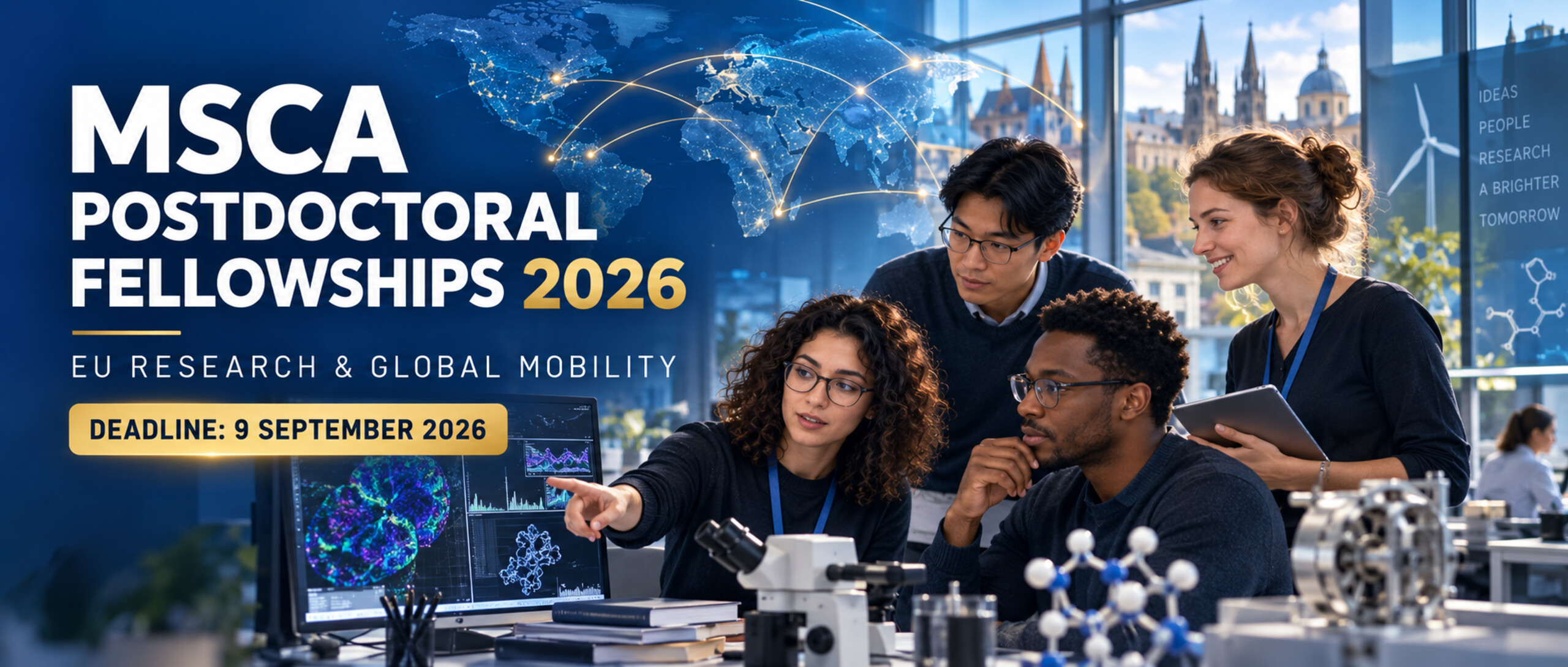
Applications are open for the Marie Skłodowska-Curie Actions Postdoctoral Fellowships 2026. Researchers with a PhD can develop an individual project with a host organisation through a 12–24 month European Fellowship or a 24–36 month Global Fellowship.
Calculating time remaining…
Global: 24–36 months
What the fellowship funds
The MSCA Postdoctoral Fellowships support researcher-led projects in any field. The researcher and host prepare the proposal together, combining an original research project with advanced training, supervision, international mobility and career development.
Living-allowance unit contribution, adjusted by the host-country correction coefficient.
Mobility-allowance unit contribution.
Family-allowance unit contribution, when applicable.
Institutional research/training/networking and management/indirect contributions.
Important: These are EU unit contributions to the beneficiary, not a promised net salary. The €6,350 living allowance is a gross amount before compulsory national deductions and is subject to a country correction coefficient. The beneficiary normally recruits the fellow under an employment contract with full social-security coverage.
Who is eligible?
- You must possess a doctoral degree by the deadline. An unconditional successful doctoral defence completed before the deadline also qualifies, even if the degree has not yet been formally awarded.
- You may have no more than eight years of full-time-equivalent research experience after the doctoral degree. The official rules exclude qualifying career breaks, time outside research and certain reintegration experience from the calculation.
- You must satisfy the mobility rule: normally, you must not have lived or carried out your main activity in the relevant destination country for more than 12 months during the 36 months immediately before the deadline.
- Only one proposal per individual researcher may be submitted.
- A proposal involving the same researcher and recruiting organisation that scored below 80% in the previous MSCA Postdoctoral Fellowships call cannot be resubmitted in 2026.
- All research and technological-development domains are eligible, including eligible Euratom areas under their additional nationality and host-country conditions.
European vs Global Fellowships
| Route | Who can apply | Mobility and duration |
|---|---|---|
| European Fellowship | Researchers of any nationality who meet the PhD, experience and mobility rules. | 12–24 months at a host in an EU Member State or Horizon Europe Associated Country. |
| Global Fellowship | Nationals or qualifying long-term residents of EU Member States or Horizon Europe Associated Countries, plus eligible refugees or EU temporary-protection beneficiaries. | 12–24 months in a non-associated third country, followed by a mandatory 12-month return phase in Europe; 24–36 months total. |
Both routes may include secondments. If justified, an additional non-academic placement of up to six months may be added at the end in an EU Member State or Horizon Europe Associated Country.
Required proposal documents and information
- Part A: the online administrative application, including participant, supervisor, researcher, budget, ethics and security information.
- Part B-1: a maximum 10-page technical narrative covering Excellence, Impact, and Quality and Efficiency of Implementation, including the work plan and Gantt chart.
- Part B-2: the researcher's CV; capacity information for the beneficiary and participating organisations; and additional ethics, security and environmental information where relevant.
- Global Fellowships: a current, signed letter of commitment from the associated partner hosting the outgoing phase. Its absence makes a proposal inadmissible.
- Supporting evidence: documentation concerning the doctorate or experience calculation may be requested during eligibility checks.
The official template, not this summary, controls the exact format and fields. Download the editable version from the submission system after starting a proposal.
How to apply
- Identify an eligible host organisation and supervisor and agree on a research and training project.
- Create or sign in to an EU Login account on the Funding & Tenders Portal.
- Open the official 2026 call page and choose Start submission.
- Add the beneficiary using its nine-digit Participant Identification Code (PIC) and enter the researcher and supervisor details.
- Complete Part A and prepare Parts B-1 and B-2 using the official 2026 template.
- For a Global Fellowship, attach the mandatory outgoing-host commitment letter.
- Validate and submit before 9 September 2026 at 17:00 CEST. A submitted proposal can be updated or withdrawn before the deadline.
Important dates
| Call opened | 9 April 2026 |
|---|---|
| Submission deadline | 9 September 2026, 17:00 CEST (Brussels local time) |
| Results expected | February 2027 (indicative) |
| Grant preparation/signature | February–May 2027 (indicative) |
| First projects start | May 2027 (indicative) |
Selection and evaluation
At least three independent external experts evaluate each proposal. The three weighted criteria are Excellence (50%), Impact (30%), and Quality and efficiency of implementation (20%). Each criterion has a threshold of 3/5, and proposals need at least 70% overall to be considered for funding, subject to budget. Eligible unfunded proposals scoring at least 85% may receive a Seal of Excellence.
Proposals are ranked within eight main evaluation panels: Chemistry; Social Sciences and Humanities; Economic Sciences; Information Science and Engineering; Environment and Geosciences; Life Sciences; Mathematics; and Physics.
Frequently asked questions
Can applicants from outside Europe apply?
Yes. European Postdoctoral Fellowships accept researchers of any nationality, provided all other eligibility and mobility rules are met. Global Fellowships have nationality or long-term-residence restrictions.
Do I need an IELTS, TOEFL or other English test?
No English-test requirement is listed in the official call documents. The proposal must still be clear and complete; applicants should follow the language and submission instructions shown in the portal.
Is there an application fee?
The official call does not list an application fee.
Can I apply without a host?
No. The researcher prepares the proposal with a host, and the application is submitted by a single eligible beneficiary organisation.
Is €6,350 the fellow's take-home salary?
No. It is the monthly EU living-allowance unit contribution before the country coefficient and compulsory deductions. Actual net pay depends on the host country, contract and applicable law.
Can someone who has defended but not graduated apply?
Yes, if the doctoral defence was successful, unconditional and completed before the call deadline. Supporting documentation may be requested.
Official sources
Ready to submit?
Use the EU Funding & Tenders Portal, start the 2026 proposal and submit well before the system closes.
Apply Now — Official PortalDeadline: 9 September 2026 at 17:00 CEST.
Related opportunities
Verification disclaimer: ScholarshipHubNow checked this article against European Commission and European Research Executive Agency sources on 8 September 2026. Official call documents and the Funding & Tenders Portal take precedence. Details may change, so verify the live call before submitting.