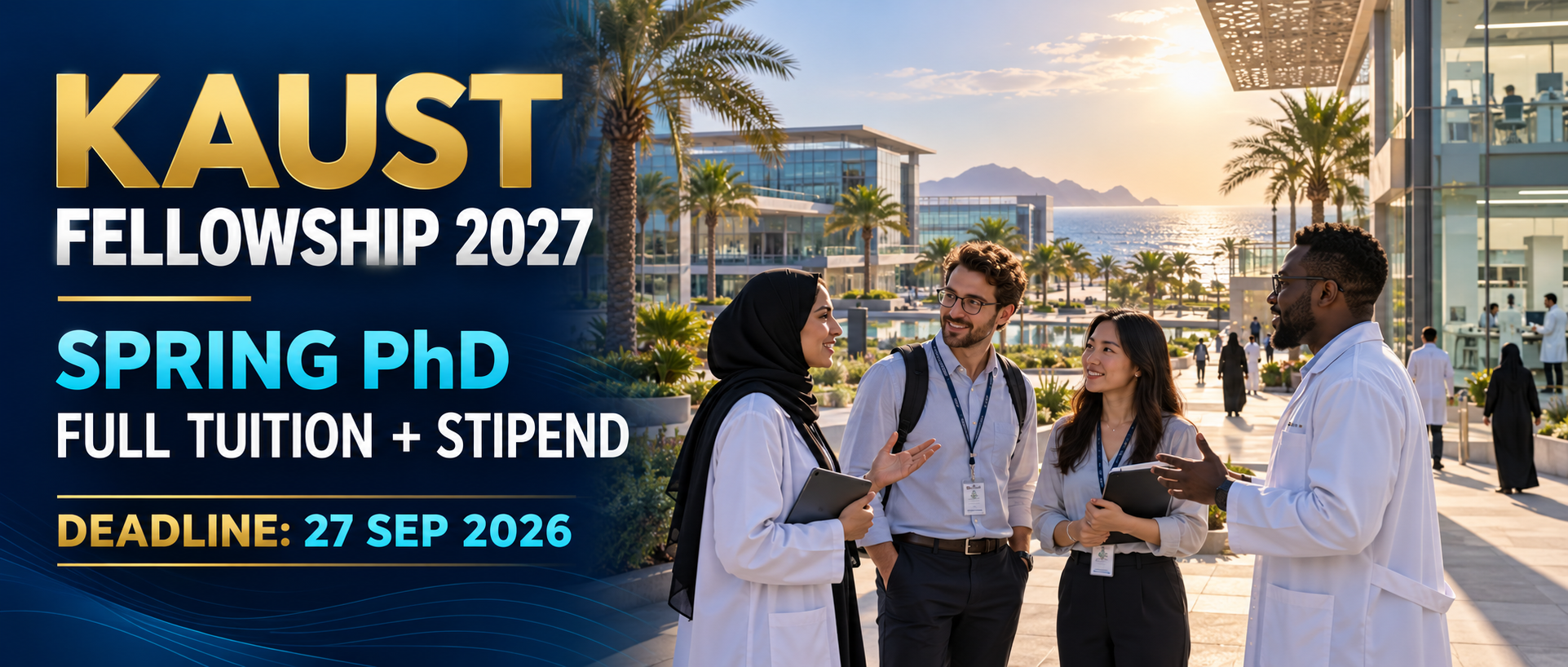
Quick answer: The KAUST Fellowship Spring 2027 PhD route is open now at King Abdullah University of Science and Technology, Saudi Arabia. KAUST’s current admissions timeline sets the Spring PhD application deadline at 27 September 2026. It does not list an exact cutoff time or time zone. Successful applicants generally receive full tuition, accommodation, health insurance, relocation assistance and a stipend; externally sponsored students may not receive the KAUST Fellowship. Spring entry is PhD-only—MS and MS/PhD applications for Fall 2027 open separately on 28 September 2026.
Host: King Abdullah University of Science and Technology (KAUST), Thuwal, Saudi Arabia
Intake and level: Spring 2027, PhD only
Audience: exceptional applicants from around the world with a relevant master’s degree
PhD duration: KAUST lists four years
Fellowship: full tuition and bench fees, stipend, base housing, health insurance and relocation support, subject to funding status
Application fee: none
Deadline: 27 September 2026; exact time/time zone not listed
Apply: official KAUST Spring 2027 PhD portal
Apply Now — Official KAUST Portal
What does the KAUST Fellowship cover?
KAUST’s official funding page lists full tuition and bench fees (worth up to US$35,000 annually), an annual PhD stipend worth US$25,000–$30,000 depending on qualifications and academic progress, base accommodation, health insurance for eligible residents and relocation, visa and travel support. KAUST calculates the overall fellowship value at US$70,000–$80,000 a year, which includes non-cash benefits; do not confuse that figure with cash paid to scholars. Relocation assistance covers the initial move and return home on graduation. Students with substantial external sponsorship may not receive the KAUST Fellowship; the offer letter defines individual benefits.
Who can apply?
KAUST invites students from around the world; the university does not list a nationality-restricted Spring PhD country list. The entry requirements specify a relevant recognised master’s degree for direct PhD admission, a minimum equivalent GPA of 3.0/4.0, age at least 18 on entry and proof of English proficiency. The MS/PhD route can start after a bachelor’s degree, but it is a Fall 2027 route not yet open as of 14 September. KAUST’s disciplines include bioscience, plant science, computer science, engineering and related STEM areas; applicants should check the listed subject and potential research fit.
Documents to prepare
- University academic records and transcripts for all higher-education institutions, with grading scales and certified English translations where needed.
- CV or résumé showing education, research and relevant experience.
- Approximately 750-word statement of purpose explaining preparation, intended field, research interests and plans.
- Names and academic/professional email contacts of three referees; KAUST requests their letters directly.
- Clear passport identity page (Saudi applicants may use a national ID).
- Official English test score if available at submission; the required score must be supplied before enrolment unless an explicit exemption applies.
KAUST accepts a recent academic record if the final degree transcript is not yet available, but final official records are required before enrolment. GRE/PGAT scores are optional. Read the full document rules.
English tests: do you need IELTS?
KAUST lists IELTS 7.0 overall with 6.5 in each section, or other specified accepted tests including TOEFL iBT, PTE Academic and Cambridge C1/C2. You may submit the application without a score, but, if admitted, must meet the English requirement before enrolment. An exemption applies to an in-person degree completed at an accredited institution in the US, Canada, UK, Ireland, Australia or New Zealand, or to a previous on-campus KAUST degree. A generic medium-of-instruction certificate is not accepted as proof, nor is Duolingo for this PhD route. Refer to the current official score table for other tests and any conditional provisions.
How to apply for Spring 2027
- Choose an eligible PhD discipline from KAUST’s study page and review entry and research requirements.
- Gather transcripts, passport page, CV, statement and willing referees. Give the referees’ institutional/professional email addresses.
- Create an account or log in at KAUST’s live Spring 2027 PhD application portal and submit by 27 September 2026. KAUST says the application itself is free; no separate fellowship form is needed.
- Track any requests from Admissions. The faculty review may lead to an online interview or assessment before the decision.
Important dates and countdown
Verified 14 September 2026: 13 calendar days remain until the Spring 2027 PhD deadline of 27 September 2026. KAUST does not list a specific hour or time zone, and calls its dates tentative, so submit early. Spring 2027 starts 17 January 2027. The separate Fall round for MS, MS/PhD and PhD opens 28 September 2026 and is scheduled to close 3 January 2027; this guide does not represent that round as already open.
Selection notes
KAUST reviews academic achievements, motivation and scientific potential. Its admissions team checks documents, then faculty evaluate and shortlist candidates for interview or test. An admission offer is not unconditional proof of a particular stipend amount: read the personal fellowship terms and disclose external sponsorship.
Frequently asked questions
Is the KAUST Spring 2027 PhD fully funded?
The university says admitted PhD students receive the KAUST Fellowship with full tuition and other benefits, subject to an exception for some external sponsorships. PhD stipends range from US$25,000 to US$30,000 annually on the current funding page.
Can bachelor’s graduates apply to this Spring PhD round?
KAUST lists a relevant master’s degree for direct PhD entry. The bachelor’s-entry MS/PhD pathway is in the Fall round, which opens 28 September.
Is the application free and is there a separate scholarship form?
KAUST’s FAQ says there is no cost to submit an application, and most admitted students receive automatic fellowship consideration without a separate form.
Can I apply without IELTS?
You can submit without a test score, but accepted English-language evidence is normally needed before enrolment unless you meet KAUST’s specific degree-based exemption. Check the official list and do not assume a medium-of-instruction letter is sufficient.
Official sources and related opportunities
- KAUST’s current admission dates
- KAUST Fellowship benefits
- Requirements, documents and English tests
- KAUST FAQ on application fee and fellowship
- Direct official Spring PhD application portal
- KAUST Global Fellowship 2027 (different postdoctoral programme)
- Sydney RTP Scholarship 2027
Verification disclaimer: This independent guide was checked against the KAUST admissions, funding, entry and application pages on 14 September 2026. It is not an official KAUST publication. Admission schedules and individual funding terms can change; confirm everything on the official pages before submitting.